As an Amazon Associate I earn from qualifying purchases, at no extra cost to you. Prices checked 20 July 2026 and change frequently.
A carbon steel wok is a thin, deep, sloping pan built for very high heat and constant motion. The steel heats fast and recovers fast, which is what lets a domestic hob get close to the searing char that defines good stir-frying. Choose a flat bottom unless you own a dedicated wok burner, and look for at least four inches of depth.
At a glance: all 4 woks compared
| Wok | Size | Flat base | Depth | Capacity | Weight | Included | Price |
|---|---|---|---|---|---|---|---|
| FGJ Pre-Seasoned | 13" | Flat | 2" | 5.8 qt | — | Lid | $33.99 |
| SUMEIGUAN Nitrided | 13.5" | 6.7" | 4.3" | 6.4 qt | — | Glass lid, spatula | $39.99 |
| YOSUKATA Pow Wok | 13.5" | Flat | 8" height | 0.44 gal | 3.6 lbs | — | $62.99 |
| YOSUKATA Blue Carbon Steel | 13.5" | Flat | — | 5.2 qt | — | — | $94.49 |
Best complete starting setup: SUMEIGUAN 13.5" (~$40)
The only wok here that arrives with everything you need: wok, glass lid and a 304 stainless spatula. It also has the best depth-to-base ratio on this page — a 6.7-inch flat base for stable induction contact, and 4.3 inches of depth, which is enough to actually toss rather than stir.
Nitriding matters more on a wok than on a skillet, because woks get washed more often and the deep shape holds water in the base where you cannot see it. See the SUMEIGUAN 13.5"
Check price on Amazon $39.99 at last check, and prices move.
Best for learning proper technique: YOSUKATA Pow Wok 13.5" (~$63)
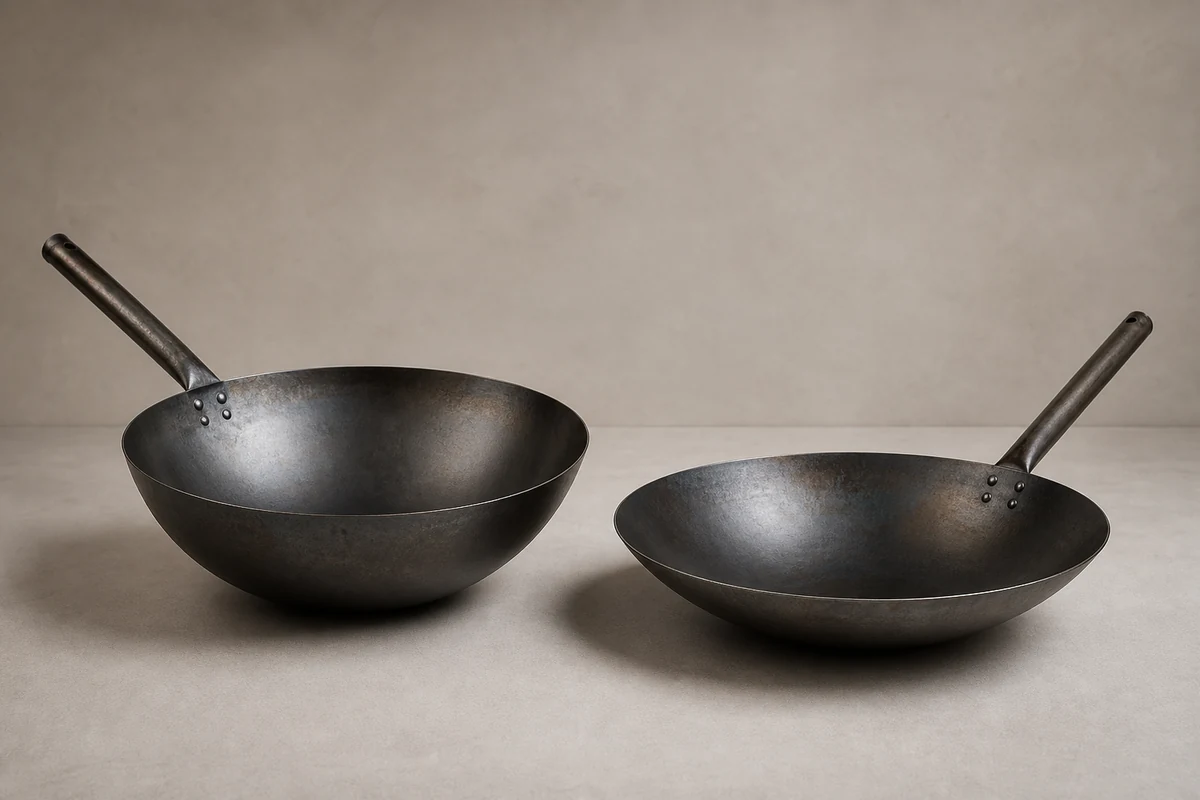
A pow wok has one long handle rather than two loops, and that exists for a single reason: it lets you toss. The flicking motion that keeps food moving through the hot zone is impossible with loop handles, and it is the technique that produces the seared, faintly smoky character good stir-frying is judged on.
At 3.6 lbs it is light enough to perform that motion repeatedly. Weight is not a virtue in a wok the way it is in a skillet. See the YOSUKATA Pow Wok
Check price on Amazon $62.99 at last check, and prices move.
Best for serious heat: YOSUKATA Blue Carbon Steel 13.5" (~$94)
Blue carbon steel is heat-treated to leave a blue-grey oxide layer that resists rust and gives seasoning something to bond to. At 15-gauge this is thicker than the budget woks here, and that thickness holds temperature when a batch of cold vegetables goes in rather than stalling. That stall is the single most common failure in home stir-frying.
Buy this if you already stir-fry regularly and have hit the limits of a thin wok. See the YOSUKATA Blue
Check price on Amazon $94.49 at last check, and prices move.
Best budget: FGJ 13" (~$34)
Factory-seasoned above 1000°F, which produces a harder starting layer than the lower-temperature pre-seasoning most woks receive. The lid extends it into steaming and braising. The one compromise is depth — at 2 inches it is shallower than ideal for aggressive tossing. See the FGJ 13"
Check price on Amazon $33.99 at last check, and prices move.
How to choose a carbon steel wok
Flat bottom, unless you have a wok burner
A round-bottom wok needs a ring or a dedicated high-output burner. A flat bottom sits directly on any hob including induction. You lose some of the extreme temperature gradient, but you gain a wok you will actually use.
Base diameter decides induction compatibility
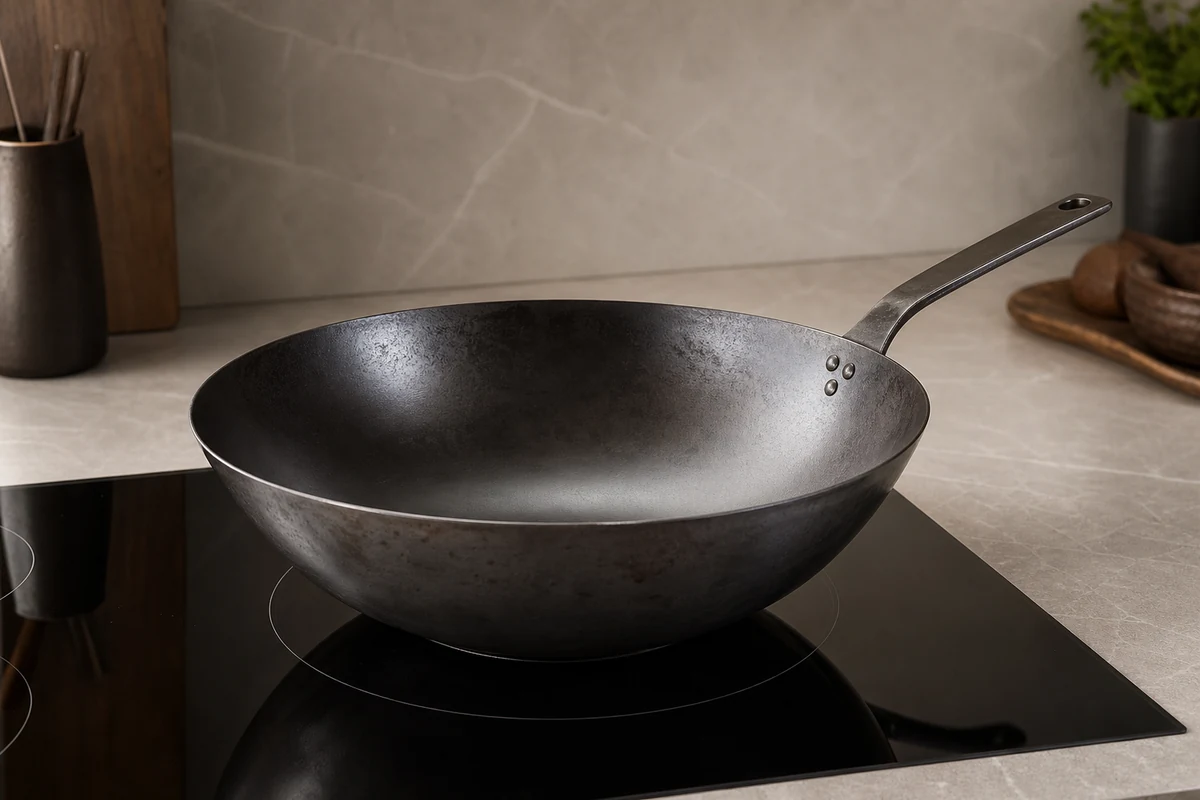
Induction hobs need enough flat ferrous metal in contact to detect the pan at all. A base much under six inches may not register on some hobs. Check the flat base measurement, not the rim diameter.
Depth is what makes it a wok
A shallow wok is just a large frying pan with sloping sides. You need enough depth to toss without redecorating your hob. Four inches or more.
Lighter is better here
Unlike a skillet, weight works against you. The tossing motion needs a pan you can flick repeatedly. Anything much over four pounds fights you.
Frequently asked questions
Can I get wok hei on a home hob?
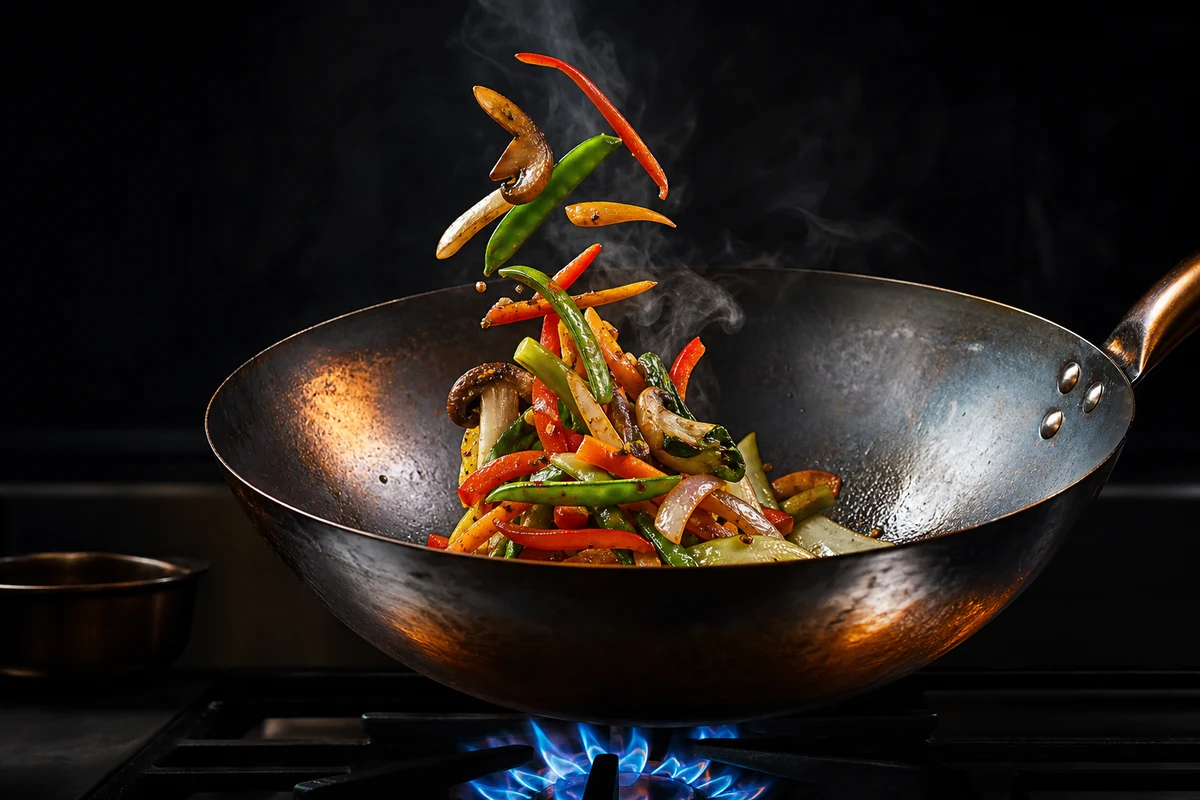
Not fully. Wok hei depends on burner output most domestic hobs cannot reach. You can get closer by preheating longer than feels sensible, cooking in small batches, and drying ingredients thoroughly before they go in. Crowding a wok is what kills the result, not the hob.
Do I need to season a pre-seasoned wok?
Yes. Factory seasoning is a protective base layer, not a finished patina. Cook something fatty in it several times before judging performance.
Flat bottom or round bottom?
Flat, for almost every Western kitchen. Round bottom only makes sense with a wok ring over a very high output gas burner, and is unusable on induction.
Why does my wok food steam instead of sear?
Three usual causes: the wok was not hot enough before food went in, you added too much at once, or the ingredients were wet. Carbon steel recovers heat quickly but it cannot overcome a full pan of cold, damp vegetables.