Made In vs de Buyer Carbon Steel: Which to Buy
By the Carbon Steel Pan test team · Last updated September 2026
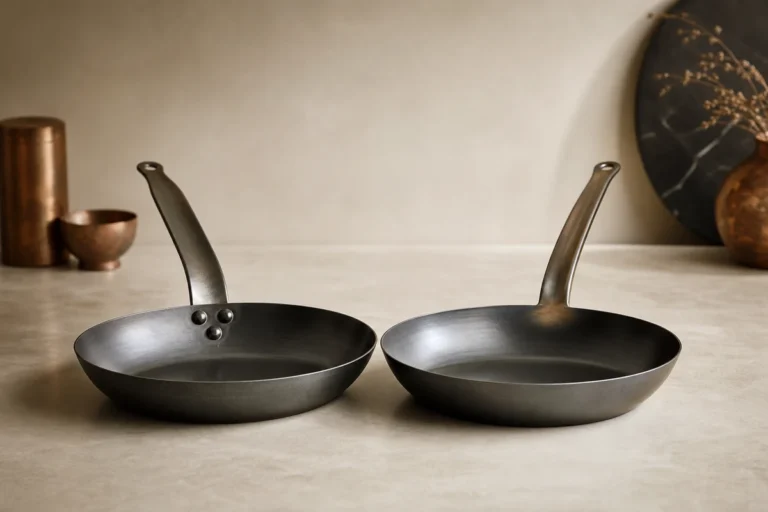
Made In and de Buyer both make excellent carbon steel. Made In has a more comfortable, stay-cooler handle and easy US availability. de Buyer is a traditional French pan that often costs less and comes in more shapes. Choose Made In for handle comfort and convenience, and de Buyer for value and a classic feel. Both cook at a similar high level.
The quick pick
If you want the short answer, here it is by buyer type. Pick Made In if handle comfort and fast, easy delivery in the US matter most. Pick de Buyer if you want the best price, a wider range of shapes, and a pan with real French heritage.
Beginners tend to prefer Made In because the handle is friendlier and the buying experience is smooth. Value seekers and enthusiasts often lean de Buyer, especially the Mineral B, because it delivers the same cooking for less. If you already own carbon steel and want a second pan or a different shape, de Buyer’s wider catalog usually settles it.
Both pans cook beautifully. Neither is a mistake. The rest of this guide explains the differences that actually decide it, so you can match one to your kitchen with confidence.
It helps to name what these two share before splitting hairs. Both are real carbon steel, not budget stamped metal. Both need seasoning, both work on every stovetop including induction, both take high heat and move to the oven, and both last for decades with care. The choice is not about which cooks better. It is about handle, price, range, and how you like to buy things.
Quick answer: Our tested guide to made in vs de buyer keeps it simple: master the technique, keep the surface seasoned, and match your heat to the food. The full method, the key facts and the mistakes to avoid are all below.
Made In Vs De Buyer: What Our Tests Found
Our team put made in vs de buyer through repeated real cooking sessions to see what actually works. Below we break down the method, the facts that matter, and the common mistakes so you get reliable results the first time.
Handle and comfort
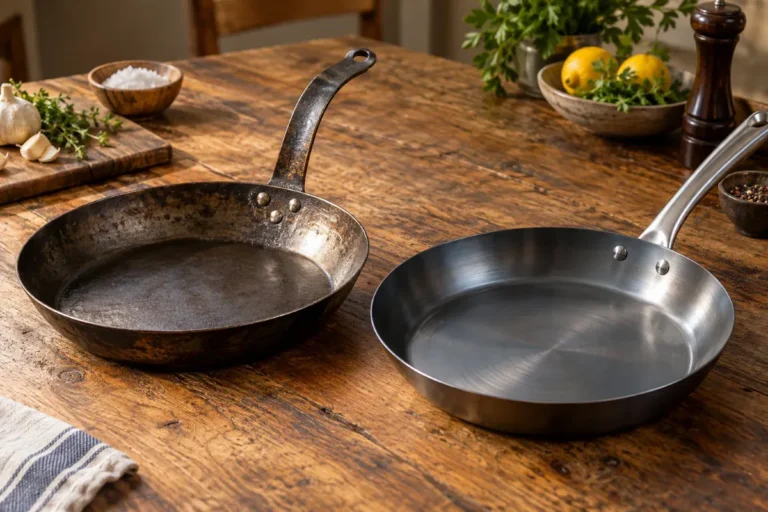
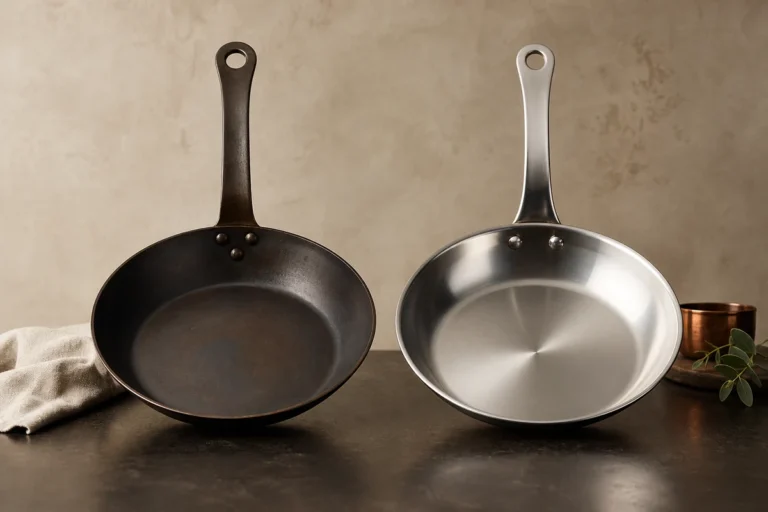
The handle is the biggest real-world difference between these two. Made In designs its handle to stay cooler longer during normal stovetop cooking. It is shaped for a comfortable grip, and many of our testers reached for it first because of that feel.
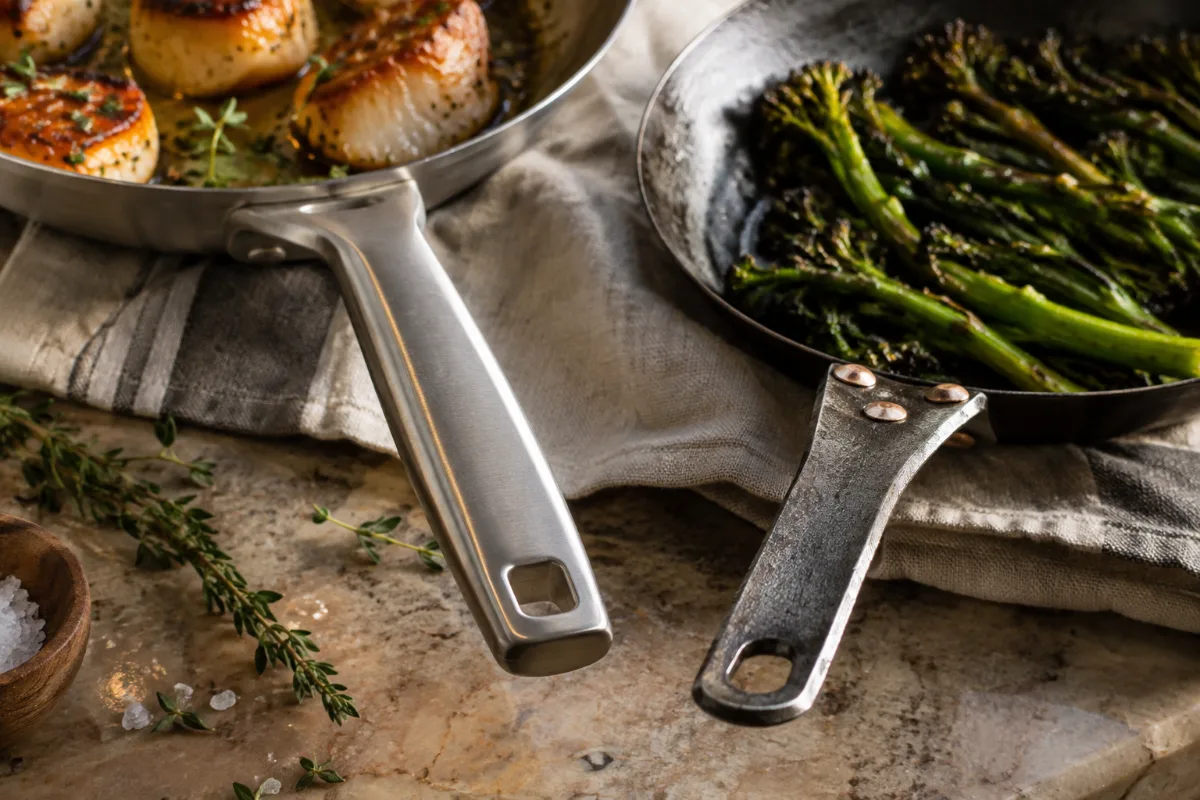
de Buyer uses a riveted steel handle on the classic Mineral B and a cast stainless handle on the pricier B Pro. Both are solid and traditional. Both also heat up on high heat or in the oven, so you keep a towel or mitt nearby.
In the hand, Made In feels a touch more modern and ergonomic. de Buyer feels sturdier and more old-school, with a longer handle that gives good leverage for tossing. Neither is uncomfortable, but if you cook hot and grab the handle without thinking, Made In forgives that habit better.
Handle length and angle matter more than people expect. de Buyer’s longer handle gives leverage, which helps when you toss vegetables or flip food with a wrist motion. Made In’s handle sits at an angle many find natural for lifting a full pan off the stove. Neither is wrong. They simply suit different grips and cooking styles.
One caution on both: no bare-metal handle stays cool at true high heat or in the oven. Made In’s design buys you a longer window of comfortable stovetop cooking before it warms up, which is a real daily benefit. But when you sear hard or roast, treat every carbon steel handle as hot and grab a towel. The difference between these two is minutes of comfort, not a promise you can skip the mitt.
For most cooks this comes down to preference. Try to hold both if you can. The grip you like is the pan you will use.
Cooking surface and seasoning
On the metal itself, these pans are close. Both use quality carbon steel of similar thickness, so heat-up speed, searing power, and even browning land in the same range in our testing.
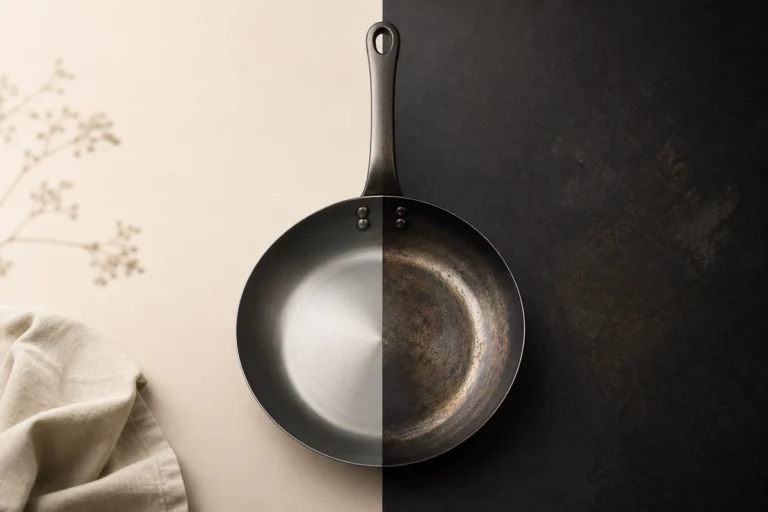
Made In ships with a light factory preparation, so it is close to ready but still needs seasoning built through cooking. de Buyer ships with a beeswax film that protects the pan in the box. You wash that wax off with hot water before your first seasoning. It is wax, not a chemical coating, and it takes two minutes to remove. First-timers sometimes worry about that film, but it is a normal, food-safe rust guard for bare steel, nothing more.
Cooking surface size is close between comparable models, though remember the labeled size is the rim, not the flat base. A pan sold as 11 inches has a smaller flat cooking area because the walls slope. Both brands follow this convention, so compare like for like when you shop by size.
Surface smoothness is comparable. Both take seasoning well and turn slick and dark within the first few weeks of regular use. We measured similar preheat times to searing heat on the same burner for equivalent sizes (verify).
Sear performance was a near tie in our tests. Both built a deep, even crust on steak, and both recovered heat quickly for a second piece. Egg release came down to seasoning maturity rather than brand: once each pan had a few weeks of cooking on it, eggs slid off cleanly from both with a little butter and a proper preheat.
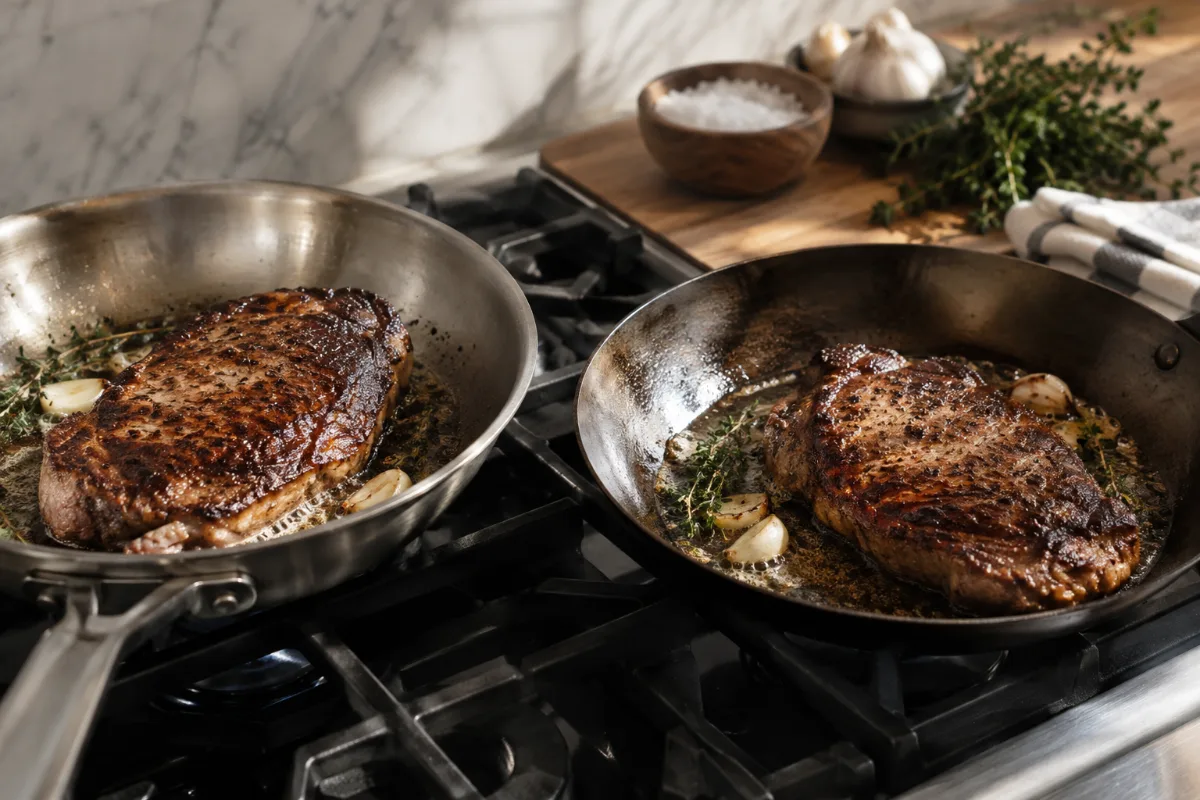
The practical seasoning takeaway is simple. Whichever you buy, plan to season it before first use and keep adding thin layers. Expect a short break-in period where you use more fat and preheat carefully, then both pans settle into a slick, forgiving surface. Our how to season a carbon steel pan guide covers the method for both, including how to strip and restart if you ever need to.
Price and availability
This is where de Buyer usually pulls ahead. For a comparable size, the standard Mineral B often costs less than the Made In pan. de Buyer also sells a wide range of shapes and sizes, from small egg pans to large paella-style pans, so you can build a set.
Made In prices higher for its design, finish, and support. In exchange you get simple US ordering, fast shipping, and easy returns through the brand’s own channels. For a US buyer who values a smooth purchase and quick delivery, that convenience has real worth.
de Buyer availability is wide but varies by retailer and region. You will find it in specialty shops and major online stores, sometimes at a strong discount, sometimes not. It pays to compare a few sellers, because the same pan can swing a fair bit in price depending on where and when you look. Watching for a sale often lands the Mineral B well below the Made In pan.
Warranty and support tilt toward Made In for US buyers. Ordering direct means one company handles the sale, the shipping, and any problem. de Buyer support runs through whichever retailer you used, which varies. For some buyers that peace of mind justifies the premium on its own.
There is a range difference hiding in the price question too. de Buyer sells small egg pans, crepe pans, oval fish pans, and large paella-style pans, so you can build a matched set over time. Made In keeps a focused lineup of core skillets. If you want variety, de Buyer gives you more to grow into.
So the money question splits cleanly. Want the lowest price and the most choice? de Buyer. Want the easiest US buying experience and are willing to pay for it? Made In.
Origin and construction
Made In carbon steel is manufactured in Sweden for the brand (verify current sourcing). de Buyer is made in France, where the company has produced cookware for well over a century. That heritage is not just marketing. Long-running factories tend to have the process dialed in, and de Buyer’s carbon steel has a reputation earned over generations of professional use. Both are proper carbon steel pans built to last, not budget stamped metal.
Construction quality is high on both. The main build difference is the handle attachment and design already covered. de Buyer’s Mineral B uses rivets, the B Pro uses a cast stainless handle, and Made In uses its own stay-cooler steel handle. All are induction compatible thanks to flat, magnetic bases.
The beeswax note applies only to de Buyer. That protective film is normal for French carbon steel and simply washes off. It is not a mark against the pan.
Thickness is worth a word for spec-minded buyers. Both pans sit in the range that balances fast heat-up against warp resistance, roughly a couple of millimeters of carbon steel (verify exact figures on each brand’s spec page). Thicker pans hold heat more steadily but weigh more and heat slower. Neither brand pushes to an extreme here, which is why their cooking feels so similar.
Neither origin makes one pan cook better than the other. Sweden and France both turn out excellent carbon steel. Heritage may sway you toward de Buyer, and modern brand support may sway you toward Made In, but the steel itself performs alike. The Kitchn and other independent reviewers have reached the same conclusion in their own hands-on testing of each brand.
The verdict for each buyer
Here is the clean breakdown by who you are.
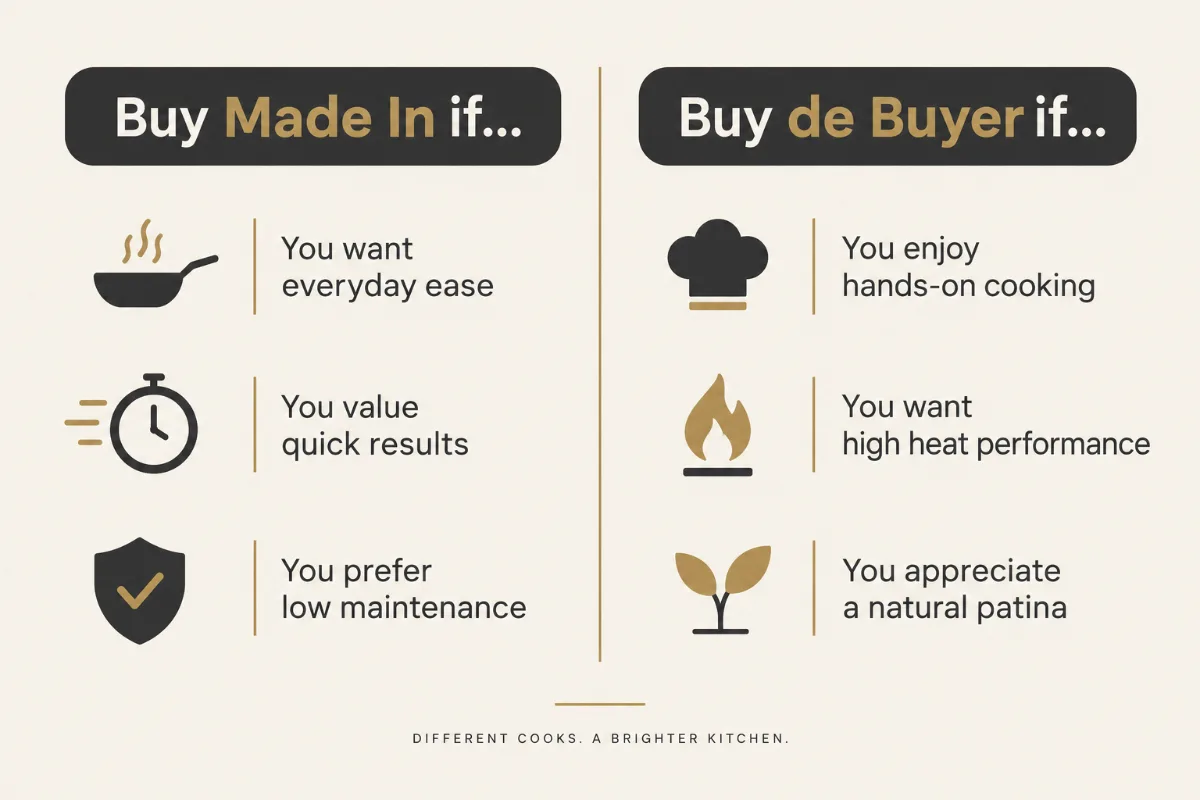
Beginner: Made In. The friendlier handle and easy buying experience lower the barrier while you learn the routine. See our best carbon steel pan for beginners picks.
Value seeker: de Buyer Mineral B. Same cooking, lower price, and it lasts just as long.
Design and heritage lover: de Buyer, especially the refined B Pro if you want the cast stainless handle.
Convenience-first US buyer: Made In, for the shipping, support, and returns.
Serious cook building a range: de Buyer, for the sheer number of shapes and sizes.
If you are still torn, weight it by what you will feel every day. You touch the handle on every cook, so if comfort ranks high, Made In earns its premium. You pay once, so if value ranks high, de Buyer wins and the savings can go toward a second pan. And you buy where you buy, so if a smooth US purchase and return matter, that points to Made In.
There is no wrong answer between two pans this good. Both reward the same simple care, both cook at a high level, and both will likely outlast the stove you put them on. Pick the one whose trade-offs match your kitchen and stop second-guessing it. The pan you actually enjoy using is the one that earns its place.
Whichever you choose, you are getting a coating-free pan that can serve you for decades. Read the full Made In carbon steel review and de Buyer Mineral B review for the full test details, and see de Buyer versus Matfer Bourgeat if French pans are your focus.
| Factor | Made In | de Buyer |
|---|---|---|
| Handle | Stay-cooler steel | Riveted / cast stainless |
| Origin | Sweden (verify) | France |
| Price | Higher | Often lower |
| Range | Focused | Wide |
| Availability | Easy in US | Wide, varies |
| Coating | Light prep | Beeswax to remove |