
As an Amazon Associate I earn from qualifying purchases, at no extra cost to you. Prices checked 22 July 2026 and change often.
The Merten & Storck 12 inch at $59.99 is the best carbon steel pan for most kitchens. It is triple-riveted, PFAS-free and large enough to sear without crowding, at roughly half the price of the European pans. Spend $26.99 on the Armorbear if you are testing whether carbon steel suits you at all.
Safety notice on the Matfer Bourgeat pans below. French regulators recalled specific lots in April 2024 after arsenic, chromium and iron leached above EU limits in acid testing. There is no US recall and Matfer disputes the finding, but America’s Test Kitchen withdrew its recommendation. We earn commission on these pans and we are telling you anyway. Full explanation here.
All ten pans compared
Read the cooking surface column, not the size column. Sloping walls mean the flat base you actually cook on runs about three inches smaller than the rim on every pan here.
| Pan | Size | Cooking surface | Weight | Handle | Origin | Price |
|---|---|---|---|---|---|---|
| Armorbear Nitrided | 10" | – | – | Wood | – | $26.99 |
| Yonida Pre-Seasoned | 10" | – | – | Metal, silicone sleeve | – | $29.99 |
| Lodge Seasoned | 10" | – | 3.12 lbs | Steel, riveted | – | $39.90 |
| Lodge Seasoned | 12" | – | – | Steel, riveted | – | $44.99 |
| Merten & Storck | 12" | – | 3.3 lbs | Triple-riveted | – | $59.99 |
| de Buyer MINERAL B Pro | 11" | 8.3" | 3.42 lbs | Cast stainless | France | $99.95 |
| Matfer Bourgeat | 11" | 8" | 4.3 lbs | Welded, rivet-free | France | $107.00 |
| Made In Seasoned | 10.25" | 7.5" | 3 lbs | Metal, riveted | Sweden | $119.00 |
| Mauviel M’Steel | 11" | 8.4" base | 4.4 lbs | Iron, riveted | France | $120.00 |
| Matfer Bourgeat | 15.5" | 12" | 8.2 lbs | Welded, rivet-free | France | $212.00 |
Best for most kitchens: Merten & Storck 12 inch, $59.99
This fills a gap almost nobody else does.
It costs about half what the French and Swedish pans cost and delivers the same core proposition: uncoated steel, no PFAS, seasoning you build yourself, no realistic end of life. Twelve inches gives you room to sear four portions without crowding, which is where most 10 inch pans fail.
The triple-riveted handle matters more than it sounds. Most pans use two rivets. A loosening handle is how riveted pans eventually die, and three rivets distribute that load meaningfully better.
What you give up: no heritage, no welded handle, no published cooking surface figure. None of it changes how dinner tastes.
See the Merten & Storck 12 inch
Check price on Amazon $59.99 at last check, and prices move.
Best for finding out if you like carbon steel: Armorbear 10 inch, $26.99
Buy this one first if you have never owned a seasoned pan.
It is nitrided, meaning the surface has been hardened in a nitrogen atmosphere. That makes it far more forgiving of the mistakes that kill a first carbon steel pan: leaving it wet, storing it damp, scrubbing too hard.
Under $30 is the right amount to spend on a question. Roughly a third of people who try carbon steel decide the routine is not for them, and finding that out for $27 is better than finding it out for $120.
The wooden handle rules out oven finishing. Accept that at this price.
Check price on Amazon $26.99 at last check, and prices move.
Best build quality: Matfer Bourgeat 11 inch, $107
Read the safety notice above before buying this one.
Setting that aside, the construction is the best here. The handle is welded rather than riveted, so nothing protrudes into the cooking surface. No ring of trapped oil around rivet heads, no fastener to work loose, and the interior wipes clean in one pass.
This is professional equipment sold to home cooks, not a consumer product styled to look professional. It is heavy at 4.3 lbs and it arrives coated in beeswax you must scrub off completely before the first seasoning.
Given the recall question, the honest recommendation is the de Buyer below unless the rivet-free interior specifically matters to you.
See the Matfer Bourgeat 11 inch
Check price on Amazon $107.00 at last check, and prices move.
Best French pan without an asterisk: de Buyer MINERAL B Pro 11 inch, $99.95
The straightforward premium choice.
de Buyer has made carbon steel in France for around two centuries, and the Mineral B is the pan most often named when professional cooks are asked what they actually use. The Pro version upgrades to a cast stainless handle, which stays cooler than the iron handles on the standard line.
The cooking surface is 8.3 inches, the largest published figure among the 11 inch pans here. It is also unusually smooth from the factory, which is a mixed blessing: the first few seasonings take longer to grip, but the finished patina is more even.
See the de Buyer MINERAL B Pro
Check price on Amazon $99.95 at last check, and prices move.
Best heat stability: Mauviel M’Steel 11 inch, $120
America’s Test Kitchen moved to Mauviel as its top pick after withdrawing the Matfer recommendation, and lab-tested it for arsenic and chromium. They tested the 12.6 inch; we stock the 11.
The steel is noticeably thicker than most competitors at 2 kg for an 11 inch pan. That shifts its behaviour toward cast iron: slower to heat, much steadier once there, and far less prone to stalling when cold protein lands. That stall is the most common reason a home sear turns into a steam.
The iron handle gets genuinely hot. Keep a towel to hand.
See the Mauviel M’Steel 11 inch
Check price on Amazon $120.00 at last check, and prices move.
Best for batch cooking: Matfer Bourgeat 15.5 inch, $212
Same safety notice applies. Also measure your hob before ordering.
At 8.2 lbs empty this is a two-handed pan when loaded, and the 12.5 inch handle needs clearance. What you get is a 12 inch flat cooking surface, the largest here by a wide margin, which means searing a whole batch at once instead of working in shifts.
See the Matfer Bourgeat 15.5 inch
Check price on Amazon $212.00 at last check, and prices move.
How to choose
Cooking surface, not stated size
An 11 inch pan gives you about 8 inches of flat base. That difference is roughly 20% in area, which is the gap between three chicken thighs browning and three chicken thighs steaming. Detail in cooking surface vs pan size.
Riveted or welded
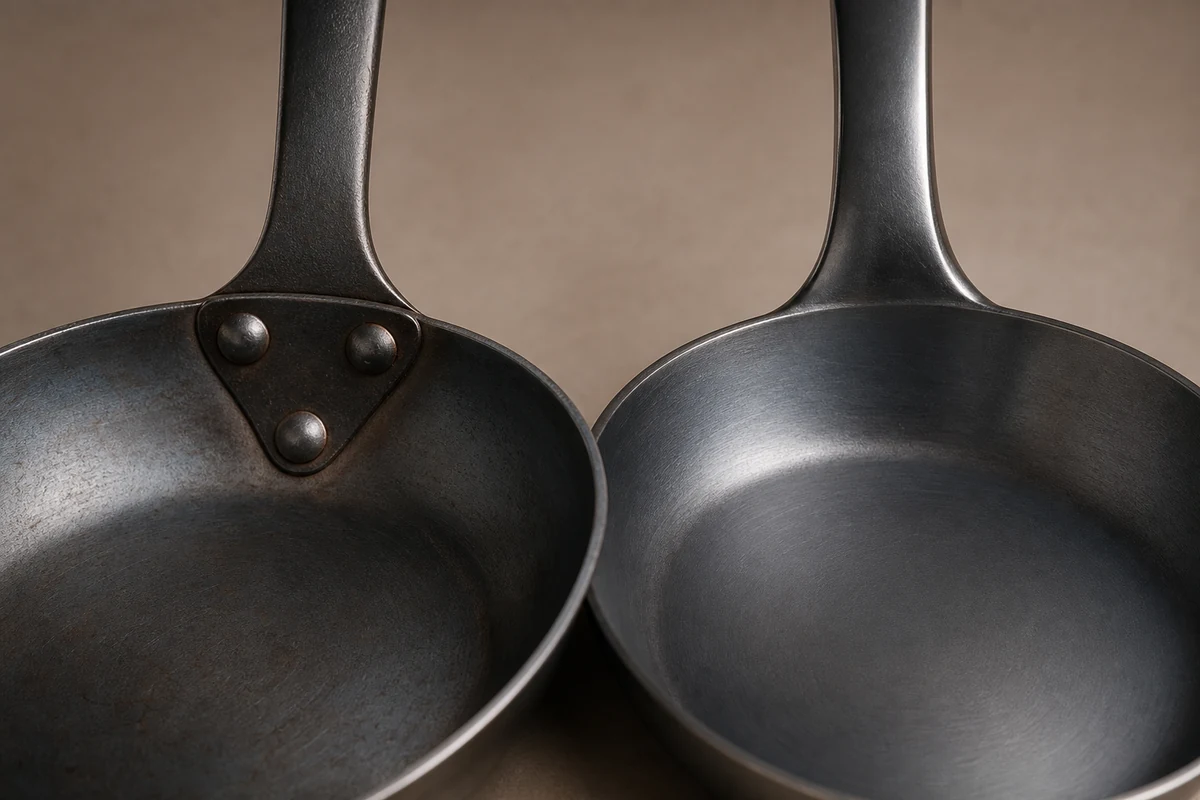
Rivets sit inside the cooking surface and trap oil. Welded handles leave it smooth and cost more. Three rivets beat two. See riveted vs welded handles.
Handle material decides oven use
Wood stays cool but bars the oven. Metal burns hands but goes under a broiler. A removable sleeve gives you both.
Thickness is a genuine trade-off
Thicker steel holds temperature when cold food lands. Thinner steel responds faster and is kinder to your wrist. Neither wins outright.
What we will not tell you to buy
Three things, and they all cost us money.
Do not buy a premium pan expecting easier ownership. The most expensive pans here have the smoothest factory surfaces, which means seasoning takes longer to bond, not less. If you want eggs sliding on day one, carbon steel is the wrong material entirely and no price fixes that.
Do not trust factory pre-seasoning to last. Made In’s own published customer reviews include repeated complaints of the seasoning peeling within two months, some with photographs, against an overall 4.7 from 11,316 reviews. That is not a reason to avoid the pan. It is a reason to treat pre-seasoning as a head start and build your own layers regardless of what you paid.
Do not buy a set. Carbon steel sets barely exist because each piece needs its own seasoning routine and most cooks use one shape. Buy one pan, learn it, then add.
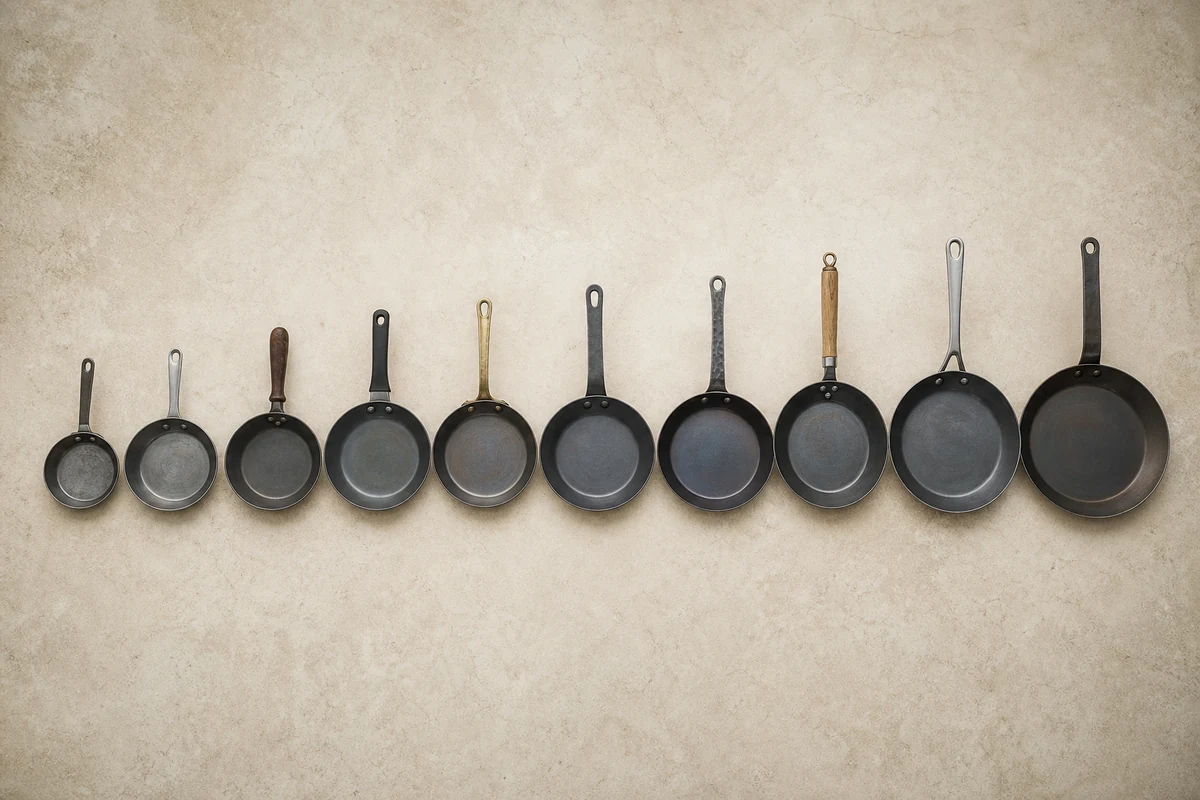
How we chose these pans
We started from what actually changes cooking, not from brand reputation. Every pan here is genuine uncoated carbon steel, checked against the manufacturer listing rather than a marketing page. We recorded the specifications that decide performance and left a cell blank rather than guess where a maker does not publish a figure.
Our full method sits on the how we test page. The short version is that we favour the pan that suits a given cook over the pan with the best story, and we will name a weakness even in a product we earn commission on.
The cooking-surface trap
Before you read the table, understand the one number that catches every buyer. Carbon steel pans are sold on rim diameter, but sloping walls mean the flat base you cook on is two to three inches smaller. An 11 inch pan gives you roughly 8 inches of usable surface.
That gap is about 20 percent in area, which is the difference between three chicken thighs browning and three steaming in their own moisture. We measured it across the range in cooking surface vs pan size. Read the cooking-surface column below, not the size column.
Handle construction, decoded
How the handle attaches affects daily use more than the price does.
| Handle type | Found on | Trade-off |
|---|---|---|
| Welded, rivet-free | Both Matfer pans | Smooth interior, nothing to loosen, costs more |
| Triple-riveted | Merten & Storck | Strong joint, small oil traps at rivets |
| Cast stainless | de Buyer Mineral B Pro | Stays cool, riveted |
| Wood | Armorbear | Cool to hold, bars oven use |
| Metal with silicone sleeve | Yonida | Hob and oven, sleeve perishes over years |
The full argument is in riveted vs welded handles.
Matching a pan to how you cook
| If you | Buy | Why |
|---|---|---|
| Are new to carbon steel | Armorbear $26.99 | Nitrided, forgiving, cheap to learn on |
| Want one pan for the family | Merten & Storck $59.99 | Large, triple-riveted, PFAS-free |
| Cook stove-to-oven often | Yonida $29.99 | Removable sleeve does both |
| Want the best construction | Matfer 11" $107 | Welded rivet-free interior, see notice |
| Want a French pan, no caveats | de Buyer $99.95 | Larger surface, cool handle, no recall flag |
| Batch cook or entertain | Matfer 15.5" $212 | 12 inch cooking surface, see notice |
Caring for whichever you choose
Every pan here needs the same routine, and it is the routine, not the pan, that decides whether you are happy in a year. Season it before first use, or build on the factory layer if it is pre-seasoned. Clean while warm, dry on the hob, wipe on a thin film of oil, and keep acid out.
The complete version is in how to care for a carbon steel pan. Skip the routine and even the $212 pan rusts. Follow it and even the $27 pan lasts decades. That is the honest hierarchy of what matters.
Where these pans are made, and whether it matters
Four of the ten are European: both Matfers and the Mauviel from France, the de Buyer from France, the Made In manufactured in Sweden. The rest come from factories the brands do not advertise, mostly in Asia.
What origin buys you is process control and consistency, visible in flatter bases, cleaner welds and finer finishing. What it does not buy is different cooking, because a flat disc of 99% iron obeys the same physics from any factory. Our advice through this guide follows from that: pay for construction you will use, the welded handle, the thick base, and not for the flag on the box.
Total cost of ownership
The price column above is the entry fee. The honest ledger has two more lines, both small.
Running costs are close to zero: a few dollars a year of oil and salt, no replacement parts, no coating to renew. The real cost is the two-minute routine after every wash, priced in attention rather than money. Pay it and the cost per year of even the Matfer 15.5″ rounds to loose change over its life. Skip it and the cheapest pan here becomes an orange lesson within a month.
Compare that with the pan category most buyers come from: coated non-stick replaced every three years or so makes even a premium carbon steel purchase the cheaper decade, as the arithmetic in are carbon steel pans worth it shows.
If you cook on induction or glass
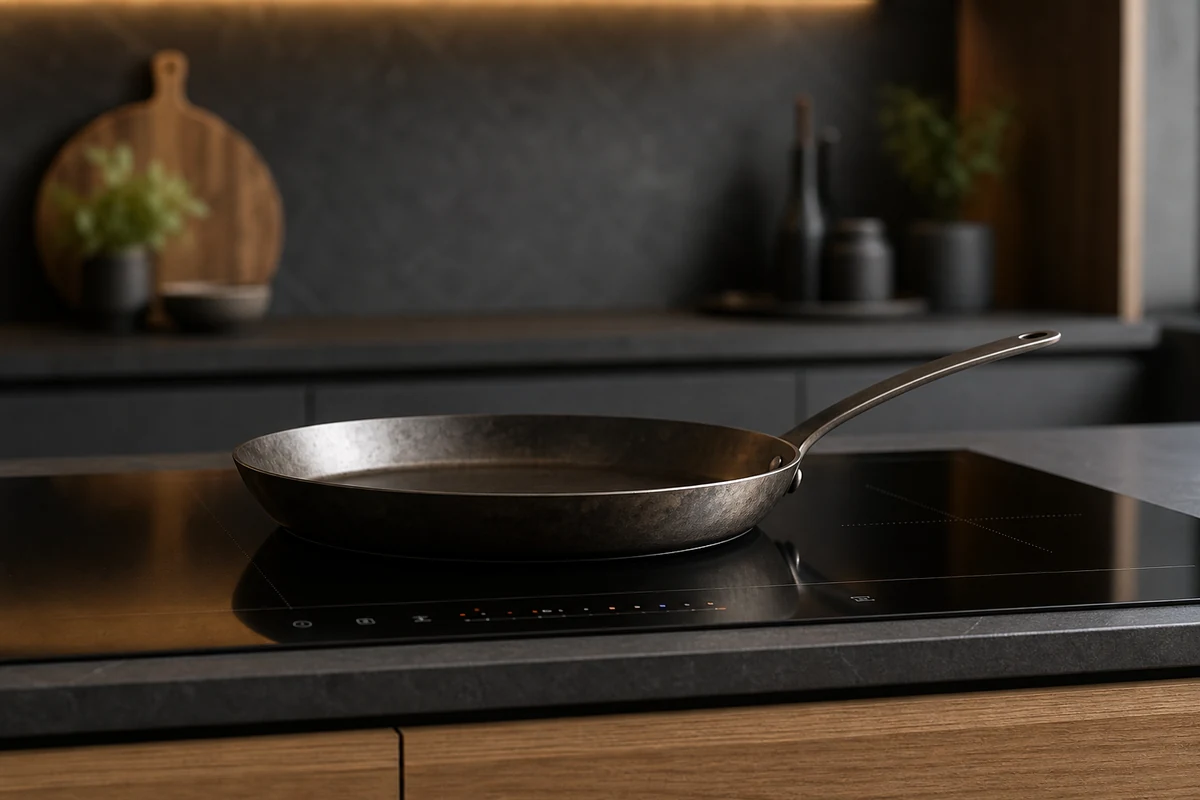
All ten pans work on induction, since carbon steel is ferrous. Three practical notes separate them.
Flatness matters most: thin budget pans can develop slight convexity with hard use, which induction hobs punish with uneven heating and glass tops announce with a wobble. The thicker pans, Mauviel especially, hold their shape best. Base contact decides detection and speed, favouring the 12 inch pans. And on glass, lift rather than slide, whatever the pan, because dragged steel eventually marks the surface.
Our review policy on these ten
Every specification in the table traces to the manufacturer or retailer listing, checked on the date in the footer, and blank cells stay blank rather than guessed. We hold no stock, take no payment for placement, and earn the same commission structure on a $27 pan as a $212 one, which is why the cheapest pan on the page is one of our top picks. When a product carries an open question, as the Matfer pans do, it is flagged at the top rather than buried. The full method is on how we test.
Frequently asked questions
What is the best carbon steel pan?
Is an expensive carbon steel pan worth it?
What size carbon steel pan should I buy?
Are Matfer Bourgeat pans safe to buy?
Which carbon steel pan is best for induction?
Do carbon steel pans come pre-seasoned?
How long will a carbon steel pan last?
A dash means the manufacturer does not publish that figure. We leave it blank rather than estimating. Specifications from manufacturer and retailer listings, prices checked 22 July 2026.