Why Do Chefs Use Carbon Steel Pans?
By the Carbon Steel Pan test team · Last updated September 2026
Chefs use carbon steel because it heats fast, responds instantly to the burner, and takes the very high heat that searing needs. It is lighter than cast iron, so it moves and tosses easily through a busy service, and it has no coating to wear out under heavy daily use. Seasoned carbon steel releases food well too, which is why it handles everything from eggs to steak.
Walk into almost any professional kitchen in France, and later many around the world, and you will find blackened carbon steel pans hanging within arm’s reach of the line. There are practical reasons for that, learned over generations of hard service. This guide breaks down each one, and then shows how home cooks can get the same benefits.
The short answer
Four qualities put carbon steel in pro kitchens: fast heat response, high-heat tolerance, light weight, and durability. Add versatility and you have a pan that does most jobs on the line without fuss.
None of these is a marketing claim. Each one solves a real problem a working cook faces every shift, and together they explain why the pan has stayed in kitchens for well over a century while trends came and went. The sections below take them one at a time.
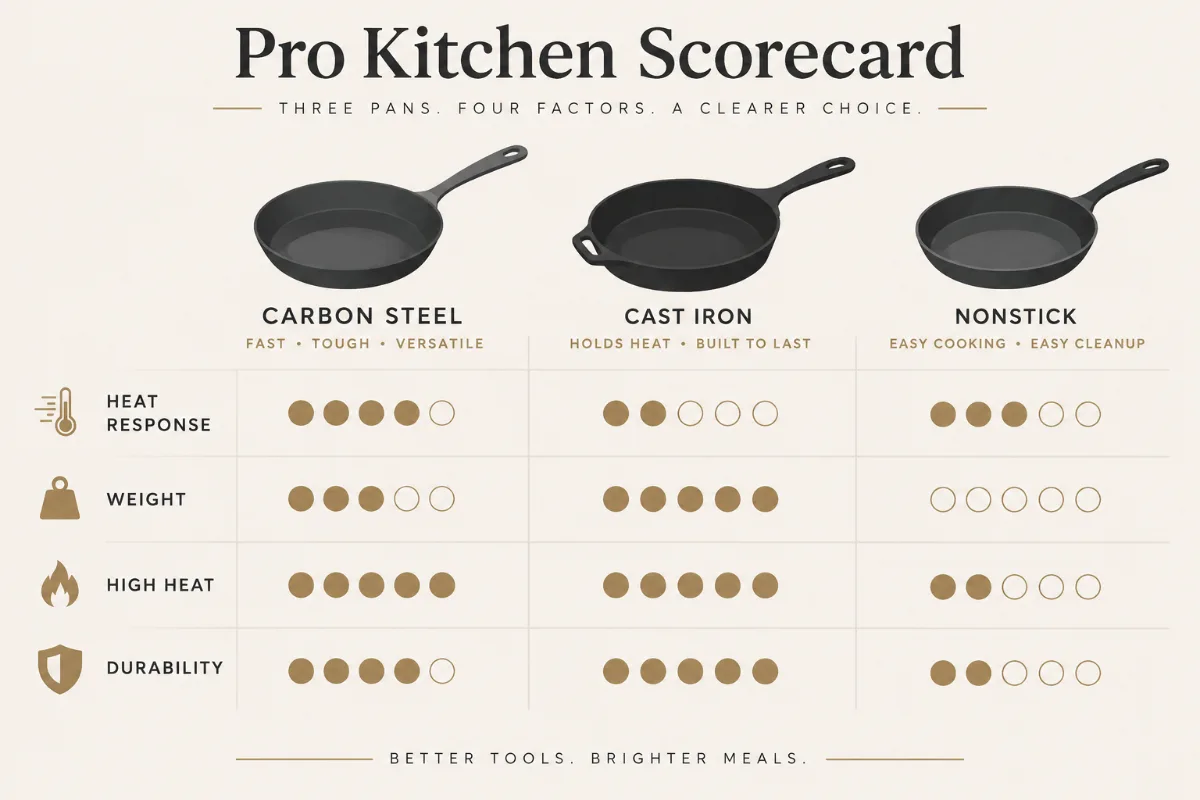
It helps to see the choice as a set of trade-offs a chef has already made. Nonstick is easy but fragile and low-heat. Cast iron is tough and holds heat but is heavy and slow to react. Stainless is durable and inert but does not build a nonstick surface. Carbon steel sits at the center: nearly as tough as cast iron, lighter and faster, able to take high heat, and slick once seasoned. For a cook who wants one pan to do the most jobs at the highest level, that balance is hard to beat.
Fast heat and quick response
The biggest professional reason is control. Carbon steel is thin metal, so it heats up in seconds and, just as important, cools quickly when you move it off the flame or turn the burner down.
That responsiveness lets a cook drive the temperature precisely. Crank the heat to build a sear, then pull back the instant the fond threatens to burn, and the pan follows almost immediately. A thick, heavy pan lags behind your commands: it stays hot after you turn it down and slow to react when you turn it up. On a busy line where timing is everything, that lag costs dishes.
Home cooks feel this too, but for a chef juggling several pans it is the difference between a clean plate and a scorched one. The pan behaves like an extension of the burner, and the cook stays in charge of the cook.
This responsiveness comes from physics, not magic. Thin steel has little thermal mass, so it does not hold much heat in reserve. Less stored heat means the pan follows the flame quickly instead of coasting on what it has banked. Cast iron does the opposite: it stores a huge amount of heat and changes temperature slowly, which is why it excels at holding a steady sear but frustrates a cook who needs to adjust fast. On a line where a sauce can break in seconds, the pan that reacts wins.
Built for high-heat searing
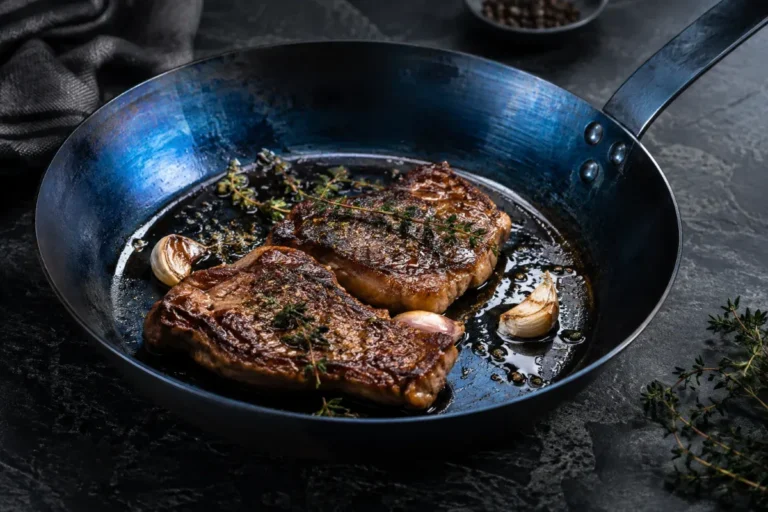
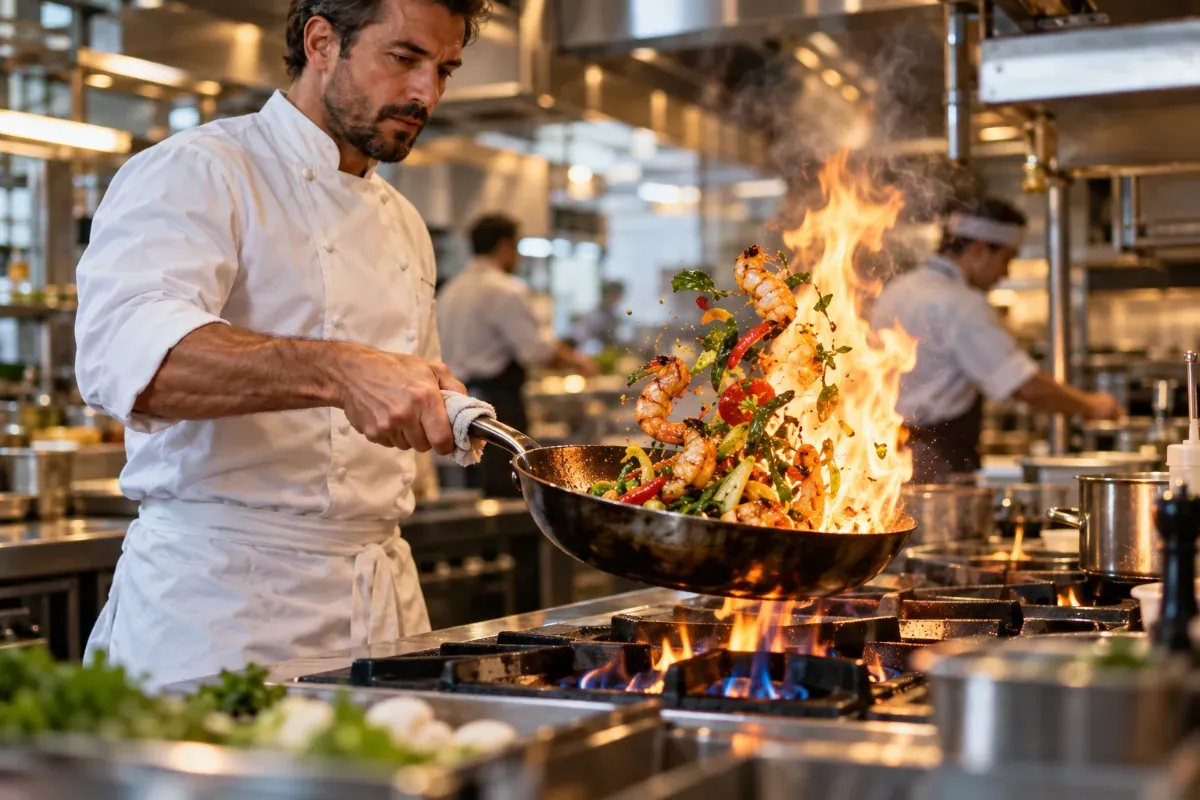
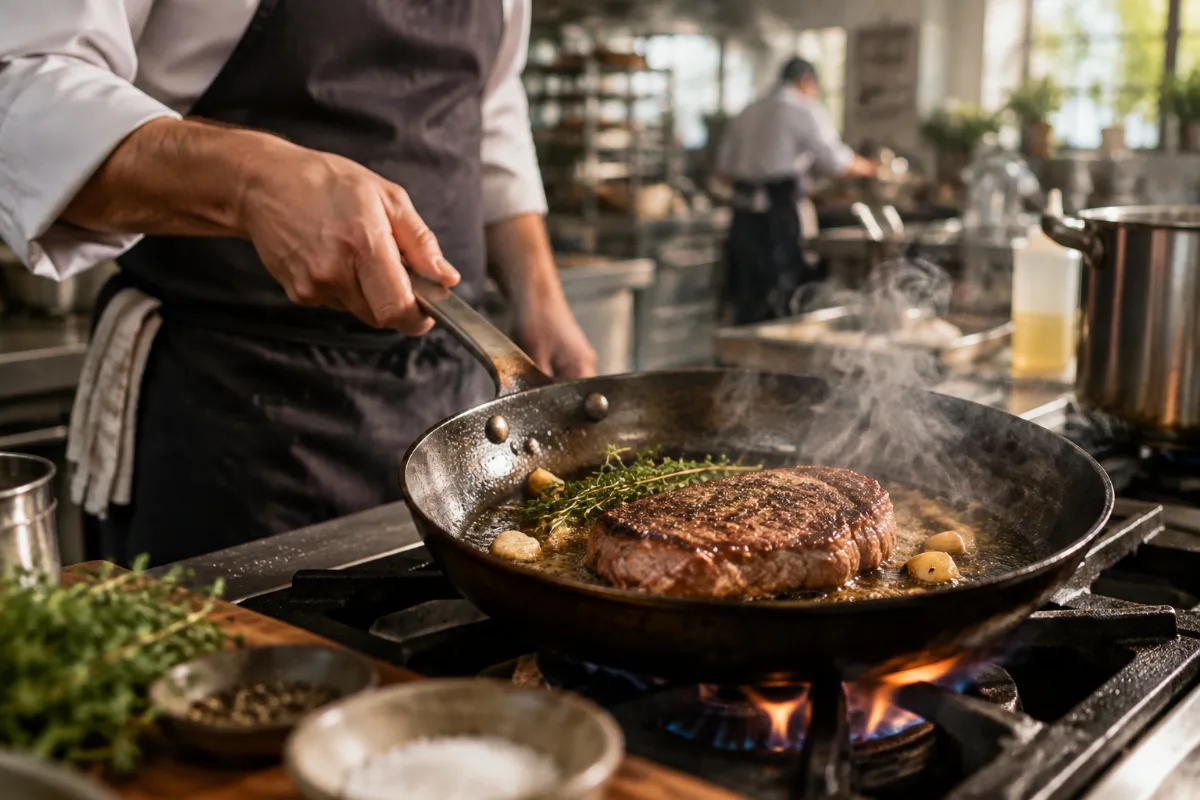
A professional sear needs serious heat, and carbon steel takes it without complaint. There is no coating to scorch, bubble, or release fumes, so a chef can preheat the pan until it nearly smokes and lay down a steak with confidence.
That high heat drives the Maillard reaction, the browning that creates the deep crust and savory flavor a good sear is all about. Nonstick coatings are rated for far lower temperatures and would break down at searing heat. Carbon steel simply gets hot and stays out of the way. For the full method, see our guide on the best pan for steak.
Because the surface is bare seasoned metal, there is also nothing to protect. A cook can use metal tongs and turners, slide the pan under a broiler, and push it as hard as the food demands.
The high-heat freedom also opens up techniques that a coated pan cannot handle. A chef can build a fond, the browned bits stuck to the pan after searing, then deglaze it with wine or stock to make a pan sauce in seconds. Those browned bits are pure flavor, and they only form on bare metal at high heat. A nonstick surface is designed to prevent exactly that sticking, so it gives up the sauce along with the sear. Carbon steel lets a cook get both the crust and the sauce from one pan.
Light enough for a busy service
Weight matters more than people expect when you cook all day. Carbon steel is meaningfully lighter than cast iron of the same size, and over an eight-hour service that difference adds up in the wrist and shoulder.
A line cook lifts, tilts, and tosses a pan hundreds of times a shift. A lighter pan makes the flip of a sauté or the swirl of a basting motion effortless, where a heavy pan turns each repetition into a small strain. Speed on the line partly depends on being able to move the pan quickly and often, and carbon steel allows that.
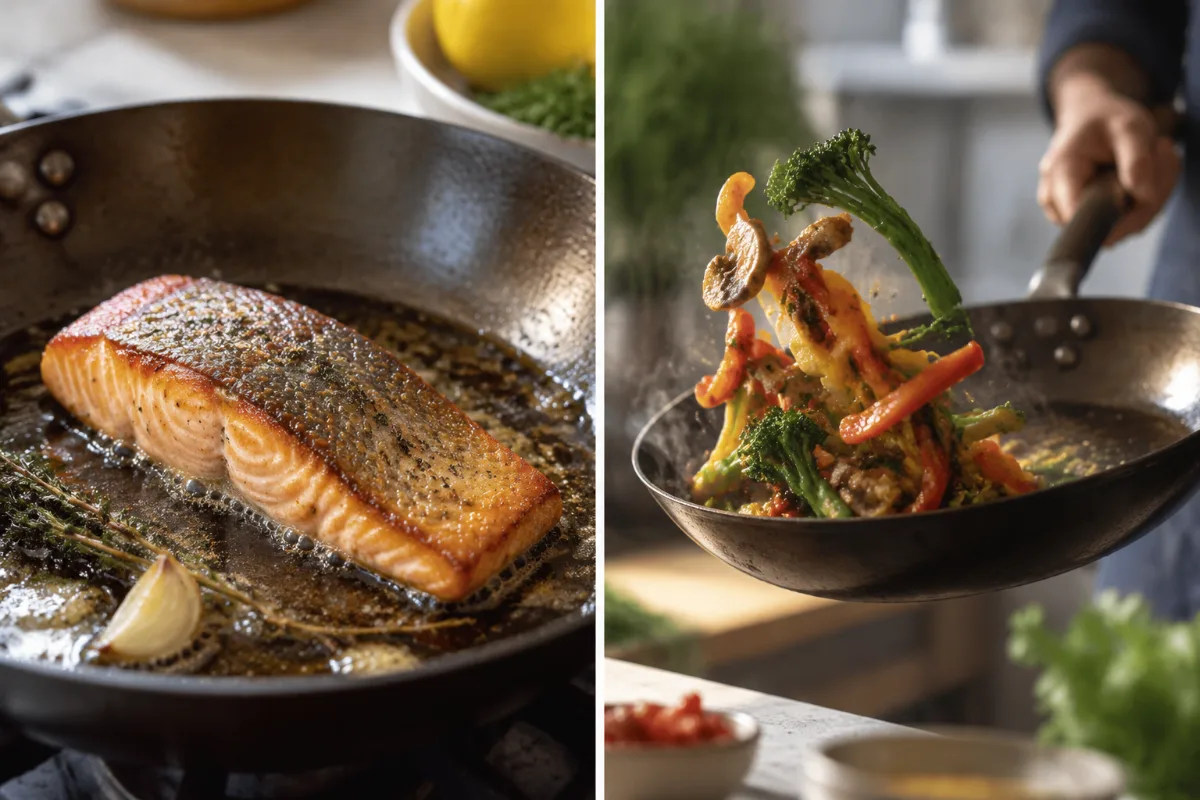
This is also why the pan suits techniques built on motion, like tossing vegetables or flipping an omelette with a flick of the wrist. The metal carries plenty of heat for the job without the dead weight of iron.
The weight difference is not small. A carbon steel pan can weigh meaningfully less than a cast iron pan of the same diameter, and a cook who lifts a pan hundreds of times feels every ounce by the end of service. Lighter pans also make one-handed work possible, so a chef can toss a sauté with one hand while plating or seasoning with the other. In a fast kitchen, that ability to work quickly and comfortably with the pan is not a luxury. It is part of getting food out on time.
Durable with no coating to replace
A professional kitchen would destroy a nonstick pan in days. Metal tools, high heat, hard scrubbing, and constant use would strip the coating fast. Carbon steel thrives under exactly those conditions.
There is no coating to fail, so metal spatulas and whisks do no harm. High heat only helps the seasoning. And when the surface does get worn or sticky, a cook re-seasons it rather than replacing the pan. The result is a tool that survives brutal daily use for years, often decades, which matters when a kitchen buys and maintains its own equipment.
That toughness is the same reason the pans last so long at home. If you want the details, we cover how long carbon steel pans last in full.
There is a cost angle for the kitchen as well. Restaurants buy equipment in quantity and replace what breaks, so a pan that lasts years instead of months is a real saving on the books. A carbon steel pan can be beaten daily, re-seasoned when needed, and kept in rotation for a decade. Replacing coated pans every few months across a whole kitchen would be an expense no chef wants to sign off on. Durability is a business decision as much as a cooking one.
The French kitchen tradition
Carbon steel’s place in professional cooking is deepest in France, where it has long been the standard pan for searing and sautéing. French culinary training built its classic techniques around this metal, and generations of cooks learned their craft on it.
That tradition spread as French-trained chefs staffed and opened kitchens worldwide, carrying the pan with them. French makers like de Buyer have produced carbon steel for well over a century, and the pans remain a fixture of restaurant supply. So when a chef reaches for carbon steel, they are often following a lineage of technique, not just picking a pan off a shelf. The metal is woven into how professional cooking is taught.
That heritage is not mere nostalgia. The pan endured because it works, and the tradition simply reflects a tool that earned its place.
You can see the same logic in Asian kitchens, where the carbon steel wok is the central cooking tool. Different cuisine, same reasoning: fast, high heat and a light body that a cook can toss through a rapid stir-fry. Two great cooking traditions on opposite sides of the world settled on carbon steel for their most demanding, heat-driven techniques. That convergence is telling. When cooks who care about results are free to choose any material, many of them land on this one.
The tradition also shapes how chefs are trained. A cook who learns to sear, sauté, and build a pan sauce on carbon steel carries that muscle memory for a career. The pan is not just equipment in these kitchens but part of the method itself, which is why it stays in use long after newer materials appear on the market.
Here is how carbon steel answers the demands of a pro kitchen.
| Chef need | How carbon steel delivers |
|---|---|
| Precise heat control | Heats and cools quickly |
| High-heat searing | Takes extreme heat, no coating |
| All-shift handling | Lighter than cast iron |
| Heavy daily use | Durable, repairable seasoning |
| One pan, many jobs | Eggs to steak to stir-fry |
Quick answer: Our tested guide to chefs use carbon steel keeps it simple: master the technique, keep the surface seasoned, and match your heat to the food. The full method, the key facts and the mistakes to avoid are all below.
Chefs Use Carbon Steel: What Our Tests Found
Our team put chefs use carbon steel through repeated real cooking sessions to see what actually works. Below we break down the method, the facts that matter, and the common mistakes so you get reliable results the first time.
What home cooks can take from this
The good news is that none of these advantages are locked to a restaurant. The same pan sits on a home burner and delivers the same fast heat, searing power, light handling, and long life.
The one thing a home cook trades for that performance is a little seasoning care, which comes down to keeping the pan dry, oiled, and in regular use. In return you get a pan that browns like a chef’s, lasts for decades, and never needs replacing. It is arguably the closest a home kitchen gets to professional-grade cooking without professional-grade prices.
The learning curve is real but short. The first few cooks teach you how the pan responds and how much fat and heat it likes, and after that the technique becomes second nature. Cooks who stick with it past the first week rarely go back, because the same qualities that keep the pan in restaurant kitchens make everyday cooking at home better too.
To understand the pan from the ground up, start with what a carbon steel pan is, and when you are ready to choose one, our carbon steel frying pans guide points you to the right one. If you are torn between materials, our carbon steel versus cast iron comparison lays out the differences.