What Is a Carbon Steel Pan? A Complete Guide
As an Amazon Associate I earn from qualifying purchases, at no extra cost to you. Prices checked 22 July 2026.
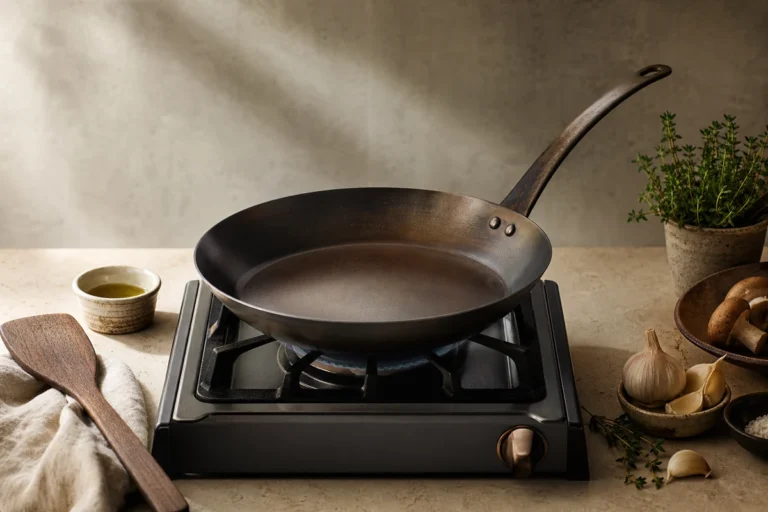
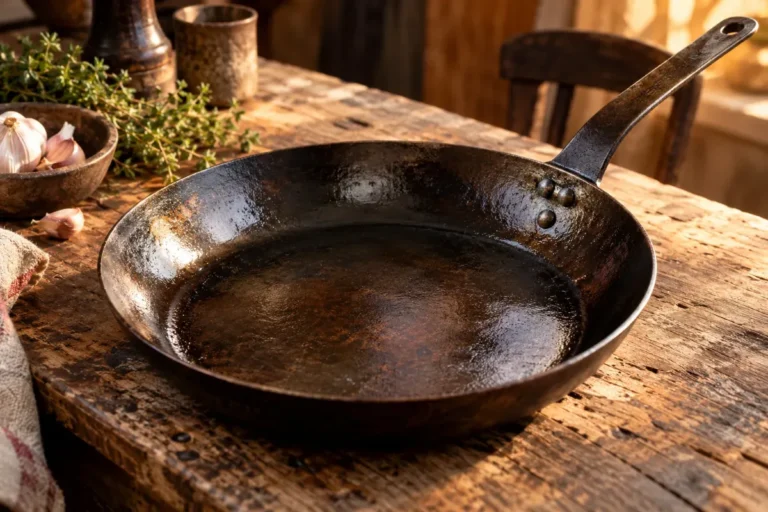
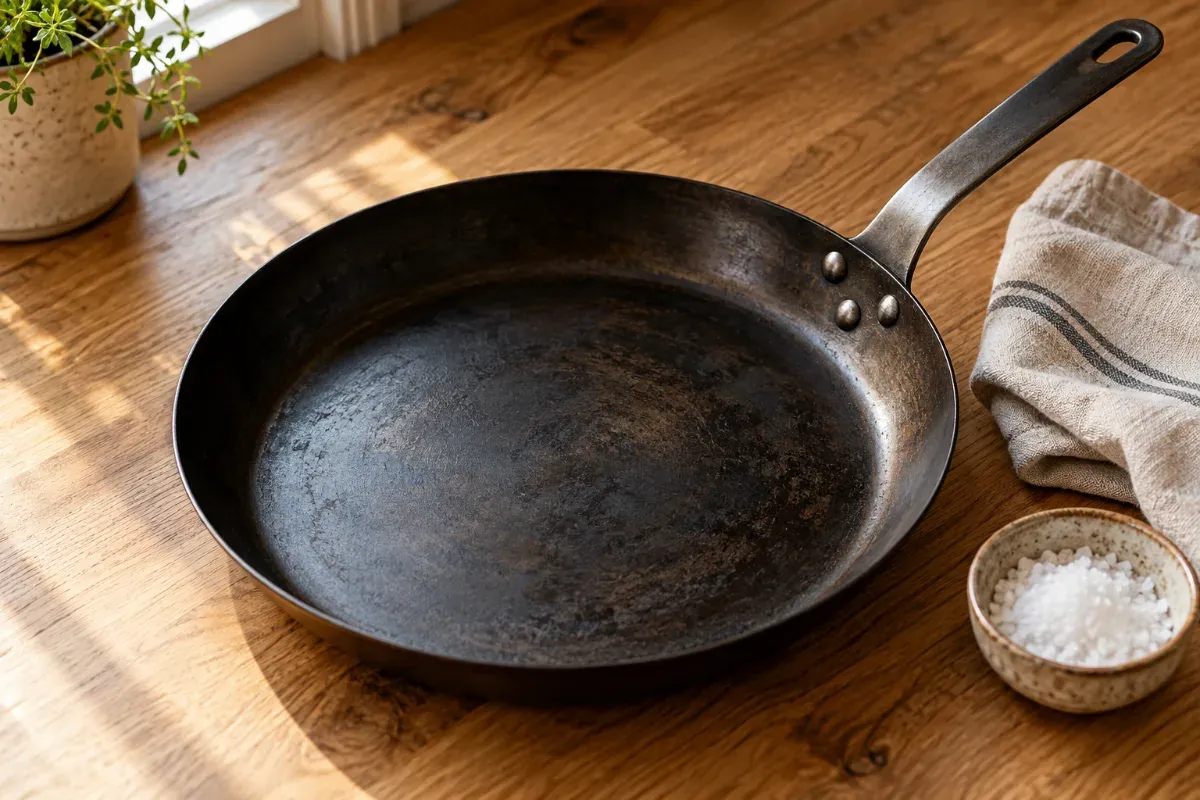
A carbon steel pan is a frying pan stamped from thin steel that is roughly 99% iron and 1% carbon. It has no coating. The non-stick surface comes from seasoning, a hard layer of polymerised oil you build through cooking. It weighs about half what cast iron does, reaches searing heat in under two minutes, and lasts for decades.
Key takeaways
- Carbon steel is an iron alloy with about 1% carbon, stamped thin rather than cast.
- It becomes non-stick through seasoning, not through a factory coating.
- It is roughly half the weight of cast iron and heats far faster.
- It rusts, dislikes acid, and sticks until seasoned, which is the trade you accept.
- A usable pan starts near $27; premium pans are better built, not easier to use.
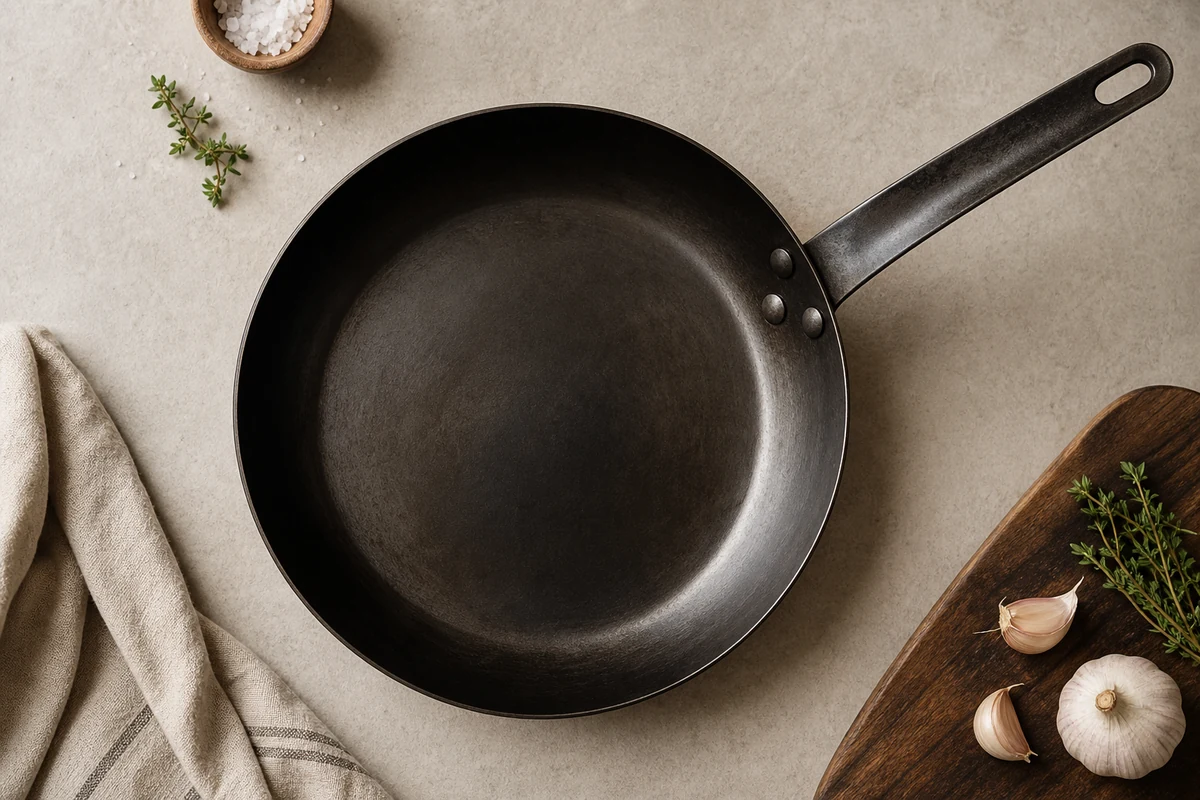
Quick answer: Our tested guide to what is a carbon steel pan keeps it simple: master the technique, keep the surface seasoned, and match your heat to the food. The full method, the key facts and the mistakes to avoid are all below.
What Is A Carbon Steel Pan: What Our Tests Found
Our team put what is a carbon steel pan through repeated real cooking sessions to see what actually works. Below we break down the method, the facts that matter, and the common mistakes so you get reliable results the first time.
What is carbon steel, exactly?
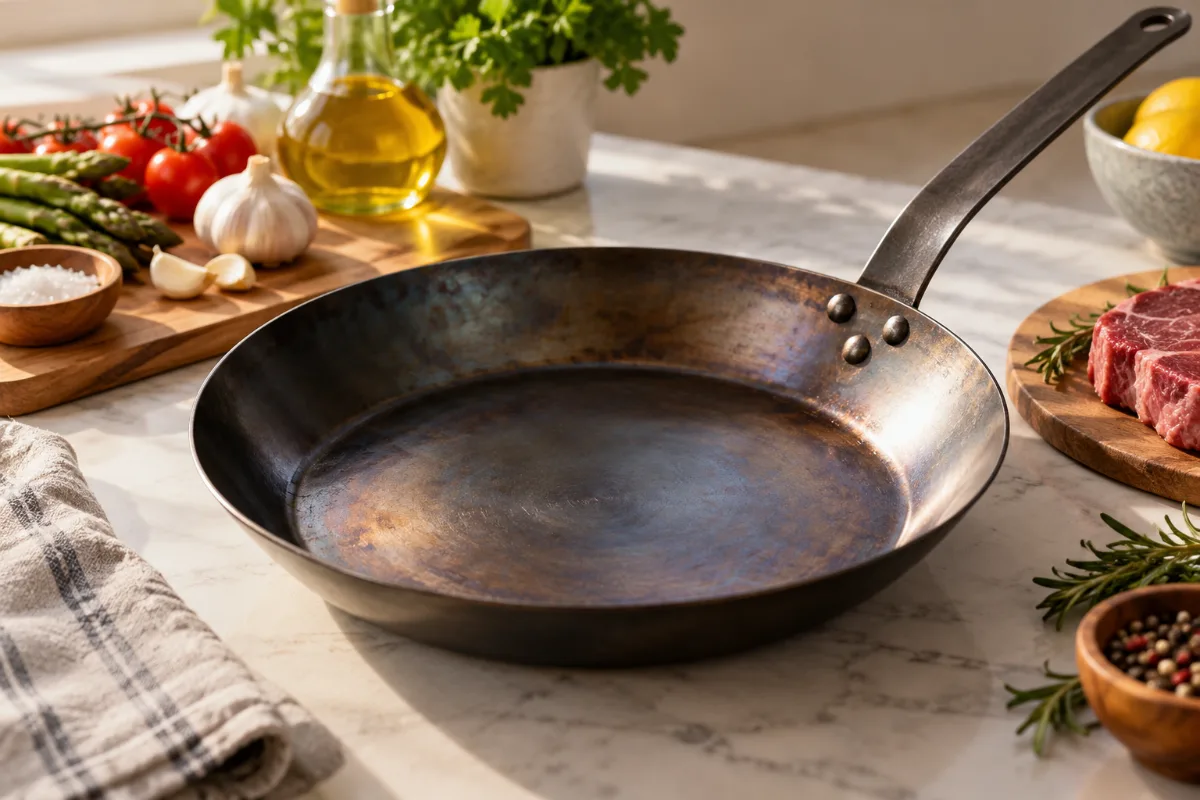
Carbon steel is iron with a small amount of carbon added. In cookware that ratio sits near 99 parts iron to 1 part carbon.
That tiny amount of carbon changes the metal completely. It makes the iron harder and stronger, so a mill can roll it into thin sheet without it cracking. This is the single fact that explains why a carbon steel pan feels the way it does in your hand.
Compare it to the alternatives and the picture sharpens. Cast iron holds far more carbon, around 2 to 4 percent, which makes it brittle. Brittle metal cannot be rolled thin, so it has to be cast thick. That thickness is why a cast iron pan is heavy. Stainless steel goes the opposite direction and adds chromium, which stops rust but also blocks the surface from ever taking seasoning.
So carbon steel sits in a genuinely useful middle. It is hard enough to be thin and light, and plain enough to build a non-stick surface. No other common cookware metal offers both at once.
Carbon steel by the numbers
| Property | Typical value | Why it matters |
|---|---|---|
| Iron content | About 99% | Makes it magnetic, so induction works |
| Carbon content | About 1% | Hard enough to roll thin |
| Chromium content | None | No rust protection, but takes seasoning |
| Thickness | 2mm to 3mm | Fast heat response |
| Weight, 10 inch | About 3 lbs | Light enough to toss |
| Heat tolerance | 500°F to 1200°F | Safe for searing and oven |
How is a carbon steel pan made?
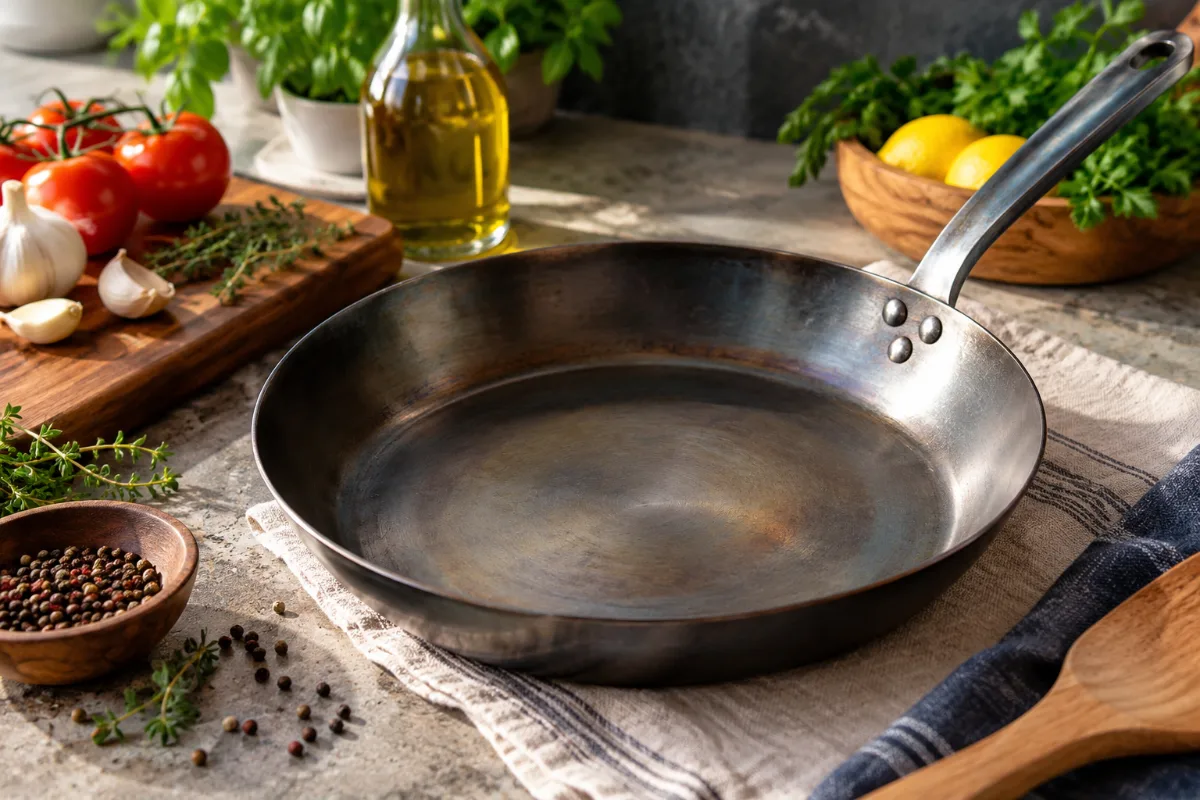
The pan starts as a flat disc of steel. A press stamps it into shape in a single motion. There is no mould and no molten metal poured, which is the core difference from cast iron.
This matters more than it sounds. Stamping produces a smooth surface. Casting produces a slightly rough, porous one. Smooth steel releases food better once seasoned, and it is the reason eggs behave differently in carbon steel than in cast iron even when both are well cared for.
The handle goes on next. It is either riveted through the pan wall or welded to the outside. That choice affects how the pan cleans and how long it lasts, which we cover in riveted vs welded handles.
Steel thickness is measured in gauge, where lower numbers mean thicker metal. Lodge uses 12-gauge steel. Some woks use 15-gauge. Made In states 2mm. A thicker pan holds heat more steadily; a thinner one responds faster to the burner.
Surface treatments you will see
Manufacturers finish the raw steel in different ways, and the names cause confusion because they all describe the same base metal.
| Finish | What it is | Effect |
|---|---|---|
| Black steel | Plain carbon steel, light factory finish | The default |
| Blue steel | Heat-treated to a blue-grey oxide | Resists rust, seasons faster |
| Nitrided | Hardened in a nitrogen atmosphere | Much more rust-resistant |
None of these removes the need to season. They change how forgiving the pan is while you learn.
What is seasoning and why does the pan need it?
Seasoning is not a coat of oil sitting on metal. That is the first thing to get straight, because the misunderstanding causes most beginner problems.
When you heat a very thin film of oil past its smoke point, the oil molecules break apart and bond to each other and to the steel. Chemists call this polymerisation. The result is a hard, dark, plastic-like layer fused to the pan. It is not liquid, it does not wipe off, and it is chemically inert.
That layer does two jobs at once. It keeps food from touching bare iron, which is what stops sticking. And it keeps moisture off the iron, which is what stops rust. One process solves both of the metal’s weaknesses.
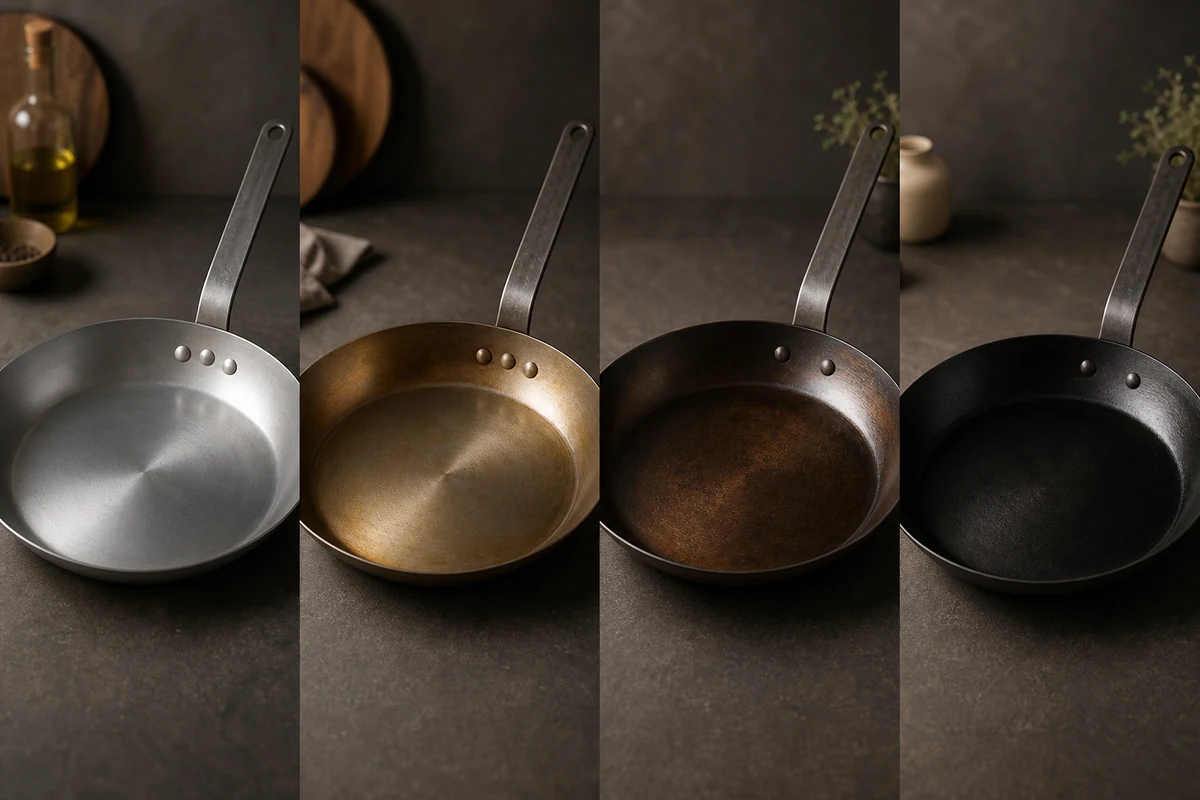
The layer builds slowly. Your pan will move from silver to gold to brown to black over weeks of cooking, and that colour change is the seasoning thickening. Thin coats are the whole trick, because a thick coat sets on the surface while staying soft underneath, which is why it peels. Our full method is in the seasoning guide.
How does carbon steel compare to other pans?
The honest comparison uses four materials, because most kitchens choose between them rather than between carbon steel brands.
| Carbon steel | Cast iron | Stainless | Non-stick | |
|---|---|---|---|---|
| Weight, 10 inch | About 3 lbs | 5 to 6 lbs | About 3 lbs | About 2 lbs |
| Time to searing heat | Under 2 min | 3 to 4 min | 2 to 3 min | 1 to 2 min |
| Holds heat | Good | Excellent | Moderate | Poor |
| Naturally non-stick | Yes, seasoned | Yes, seasoned | No | Yes, until worn |
| Handles acid | No | No | Yes | Yes |
| Coating to wear out | None | None | None | Yes |
| Dishwasher | No | No | Yes | Usually no |
| Lifespan | Decades | Generations | Decades | 2 to 5 years |
The row that decides most purchases is the last one. A coated pan is a consumable you replace every few years. Carbon steel is not. For a deeper treatment see carbon steel vs cast iron and carbon steel vs stainless steel.
What is a carbon steel pan good at?
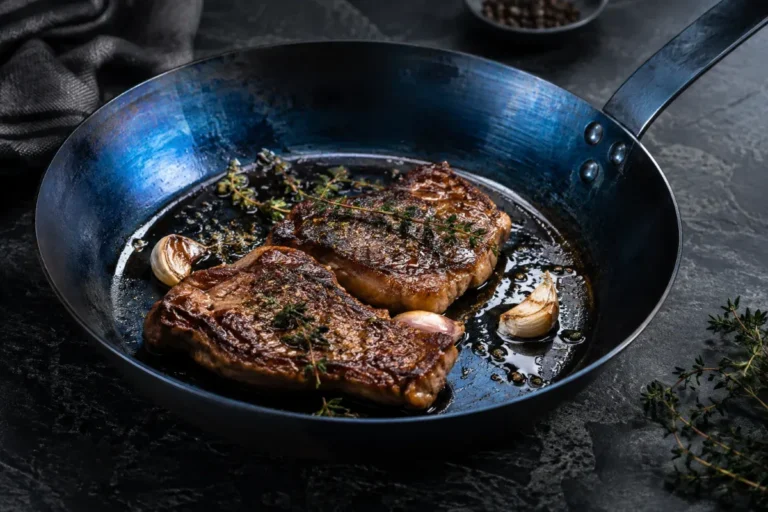
Searing, above all. The steel gets very hot and recovers quickly when cold food hits it. That recovery is what separates a browned steak from a grey, steamed one, because a pan that stalls in temperature cannot drive the Maillard reaction that builds a crust.
It is also good at anything involving movement. Sloping walls and low weight let you toss and flip. Try that with cast iron and your wrist will object within a week.
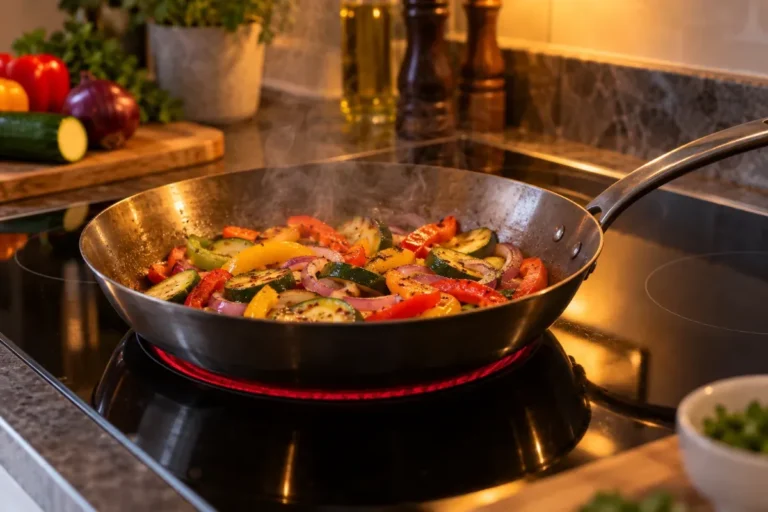
Once the seasoning matures, eggs release cleanly and fish skin lifts without tearing. Stir-fry suits it because the pan follows the burner instantly, dropping and climbing in temperature as fast as you change the heat.
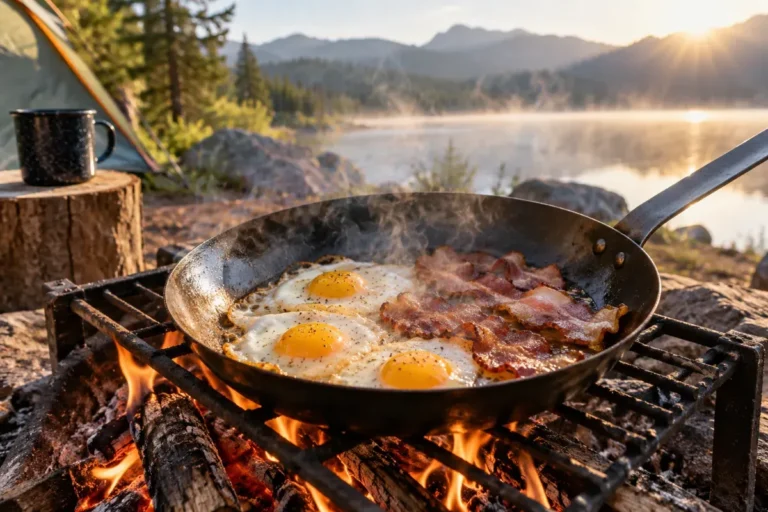
It also travels. Carbon steel goes in the oven, onto a grill, and over an open fire. Only the handle limits you, since wood cannot take oven heat while metal can.
Best uses, by dish
| Dish | Carbon steel rating | Note |
|---|---|---|
| Steak, chops | Excellent | Its core strength |
| Stir-fry | Excellent | Fast response, low weight |
| Fried eggs | Very good, once mature | Needs a built-up surface |
| Pan-roasted chicken | Excellent | Hob to oven in one pan |
| Tomato sauce | Avoid | Acid strips seasoning |
| Caramel | Avoid | Sugar bonds to the layer |
What is it bad at?
Acid. This is the real limit and it is not negotiable. Tomatoes, wine, vinegar and lemon dissolve seasoning, and a long simmer will strip the pan back several layers and leave a metallic taste in the food. Deglaze quickly and get the liquid out, or reach for stainless. We list the full set in what not to cook in a carbon steel pan.
Sugar is the second problem. Melted sugar bonds to seasoning and tears it off when it sets, so caramel and confection belong in a different pan.
It cannot go in the dishwasher, cannot soak in the sink, and cannot be put away wet, because iron plus water equals rust within hours. And it will stick when new. Every carbon steel pan sticks until the seasoning builds, and this is the point where most people give up.
Who should not buy a carbon steel pan?
Some readers should walk away, and no other guide will tell you that plainly.
If you want a pan that works perfectly the first time and forgives everything, buy stainless or a decent coated pan. Carbon steel asks for weeks of patience before it behaves. If you cook a lot of tomato sauce, braises, or anything acidic, this is the wrong material for that job. If a pan sitting in the sink overnight is a normal event in your kitchen, you will spend your life fighting rust. And if you have limited grip strength, a loaded 12 inch pan with a long handle carries real weight.
None of that is a criticism of the material. It is a question of whether the trade suits how you actually cook, rather than how you imagine you will cook.
How much should you spend?
Less than you think. The expensive pans are better made, with welded handles, smoother surfaces, thicker steel, and European or Swedish manufacturing. What they do not give you is an easier start, because the smoothest premium surfaces take longer to season, not less.
A $27 nitrided pan and a $212 professional pan both cook by the same physics. If you are new to this, buy cheap and find out whether you enjoy the routine before you commit real money. Our comparison of ten pans covers the range from $26.99 to $212, and our beginner guide explains why starting cheap is the smart move.
Living with the pan, briefly
The daily routine is short once it is habit. Clean while warm, dry on the hob rather than a rack, wipe on a thin film of oil, and put it away. Under two minutes. The full version, including what your pan looks like at ten, thirty, and a hundred cooks, is in how to care for a carbon steel pan.
The part worth repeating is the first month. A new pan sticks, and it keeps sticking until the seasoning builds, which is exactly when people conclude they were sold a dud. They were not. If yours is sticking, our guide to why carbon steel pans stick covers the five real causes.
Where carbon steel pans come from
Carbon steel cookware is old, and two traditions shaped what you can buy today.
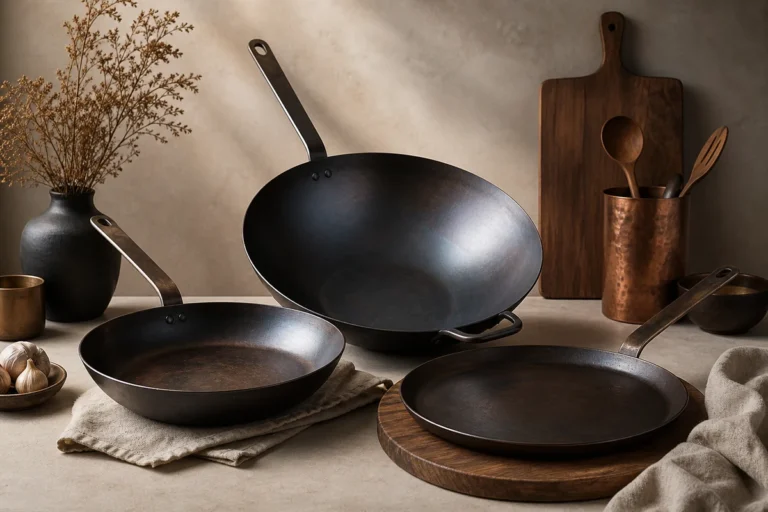
The French tradition built the flat frying pan. Makers like de Buyer and Mauviel have produced carbon steel skillets for well over a century, aimed first at professional kitchens where a pan is used hard every day and expected to last a working lifetime. The heavy French pan with its riveted iron handle descends directly from that world.
The Chinese tradition built the wok. Thin carbon steel over a fierce flame is the foundation of stir-fry, where the metal has to climb and drop in temperature within seconds. The flat-bottomed woks sold for Western hobs adapt a design far older than any frying pan.
Both traditions arrive at the same material for the same reason. Iron cooks well and takes seasoning, and a little carbon lets you roll it thin. Everything else is shape and handle.
Why seasoning works, in plain terms
Understanding the science explains every rule you will read about carbon steel.
Cooking oil is made of long fat molecules. On their own they stay liquid and wipe away. Heat them past their smoke point and the molecules break and re-link into a large connected network. That network is a solid. It grips the microscopic texture of the steel and holds fast.
This is the same class of reaction that hardens linseed oil into a finish on wood or on an oil painting. The cooking version simply happens faster and hotter.
Two consequences follow. Thin layers work and thick layers fail, because only a thin film fully converts while a thick one sets on top and stays gummy underneath. And the finished layer is genuinely tough, which is why soap does not remove it and why metal utensils do not scratch it off. Physical abrasion and acid are the only things that break it in normal use.
The four alternatives, in detail
Against cast iron
The closest cousin. Same iron, same seasoning, same rust risk. Cast iron is thicker, heavier and holds heat longer, which suits a single thick steak or an oven bake. Carbon steel is lighter and faster, which suits weeknight cooking and anything you toss. Most cooks who own both reach for carbon steel more often, simply because it is easier to lift.
Against stainless steel
The true opposite. Stainless never rusts, never seasons, and handles acid without complaint, so it is the pan for tomato sauce and pan sauces. It never becomes non-stick, though, so eggs and fish are a fight. Carbon steel and stainless cover each other’s weaknesses, which is why serious kitchens keep both.
Against coated non-stick
Non-stick wins on day one and loses over time. It is effortless when new, uses almost no oil, and cooks a bare omelette carbon steel cannot match. Then the coating wears, usually within a few years, and the pan becomes landfill. Carbon steel starts harder and improves for decades. It is the difference between renting and owning.
Against ceramic
Ceramic is the newest and shortest-lived. The coating is inert, which appeals to buyers avoiding PTFE, but it commonly loses its release within a year or two. As a long-term pan it is the weakest option here.
What carbon steel costs over twenty years
The sticker price hides the real number.
| Coated non-stick | Carbon steel | |
|---|---|---|
| Price per pan | $30 to $60 | $27 to $212 |
| Replaced every | 2 to 5 years | Does not need replacing |
| Pans bought in 20 years | About 7 | 1 |
| Performance trend | Declines | Improves |
| End of life | Landfill | None yet |
Even a $120 carbon steel pan is cheaper across twenty years than a rotation of budget non-stick, and you finish with a better pan than you started with. We work through this in are carbon steel pans worth it.
Common myths worth clearing up
You can never use soap. False. Modern dish soap does not touch polymerised seasoning. The myth is a holdover from caustic lye soaps that no longer exist in your kitchen.
Pre-seasoned means ready to use. Misleading. Factory seasoning is one or two thin layers for transit protection, not a finished surface. You still build the real patina yourself.
Flaxseed oil is the best seasoning oil. Overstated. It builds the hardest layer, but that layer is brittle and flakes. Grapeseed or canola gives a more durable result, covered in best oil for seasoning.
Carbon steel is only for professionals. False. The skill it asks for is a two-minute cleaning habit and a month of patience, not chef training.
Rust means the pan is ruined. False. Rust on carbon steel is cosmetic and scrubs off. The pan underneath is fine, as our rust guide shows.
Is carbon steel a sustainable choice?
By the standards of cookware, yes, and it is one of the quieter reasons to buy it.
A pan that lasts decades and can then be recycled as scrap steel has a smaller lifetime footprint than a coated pan replaced every few years. There is no coating to manufacture, none to dispose of, and no plastic in the cooking surface at all. When a carbon steel pan finally reaches the end of its life, it is simply steel, among the most recycled materials on earth.
Your first carbon steel pan
The theory is simple enough that the only real way to learn it is to own one. Start at $26.99 with the Armorbear 10 inch nitrided pan, which is the most forgiving pan we list, or at $39.90 with the Lodge 10 inch if you want a name you recognise. Neither purchase locks you in. The comparison table covers all ten skillets if you would rather see the specs side by side.
Frequently asked questions
Is a carbon steel pan the same as a wok?
Is carbon steel safe to cook on?
Does a carbon steel pan work on induction?
How long does a carbon steel pan last?
Can you use soap on carbon steel?
Why does my new carbon steel pan stick?
What is the difference between black steel and blue steel?
Specifications from manufacturer listings, checked 22 July 2026. Prices change often, so confirm before buying.