How Long Do Carbon Steel Pans Last?
By the Carbon Steel Pan test team · Last updated September 2026
A carbon steel pan lasts for decades, and often a lifetime, because there is no coating to wear out. Keep it seasoned and dry and the surface can always be rebuilt, while the metal itself does not degrade. Only neglect that leads to deep rust or a bad warp ends a pan early, and both are preventable. Spread over that lifespan, the cost per year is tiny.
That is the honest answer, and it is the strongest argument for buying carbon steel in the first place. A pan you use several times a week for thirty years is a different kind of purchase than one you replace every couple of years. This guide proves the longevity claim, shows the rare things that actually kill a pan, and does the value math against nonstick.
The short answer: decades
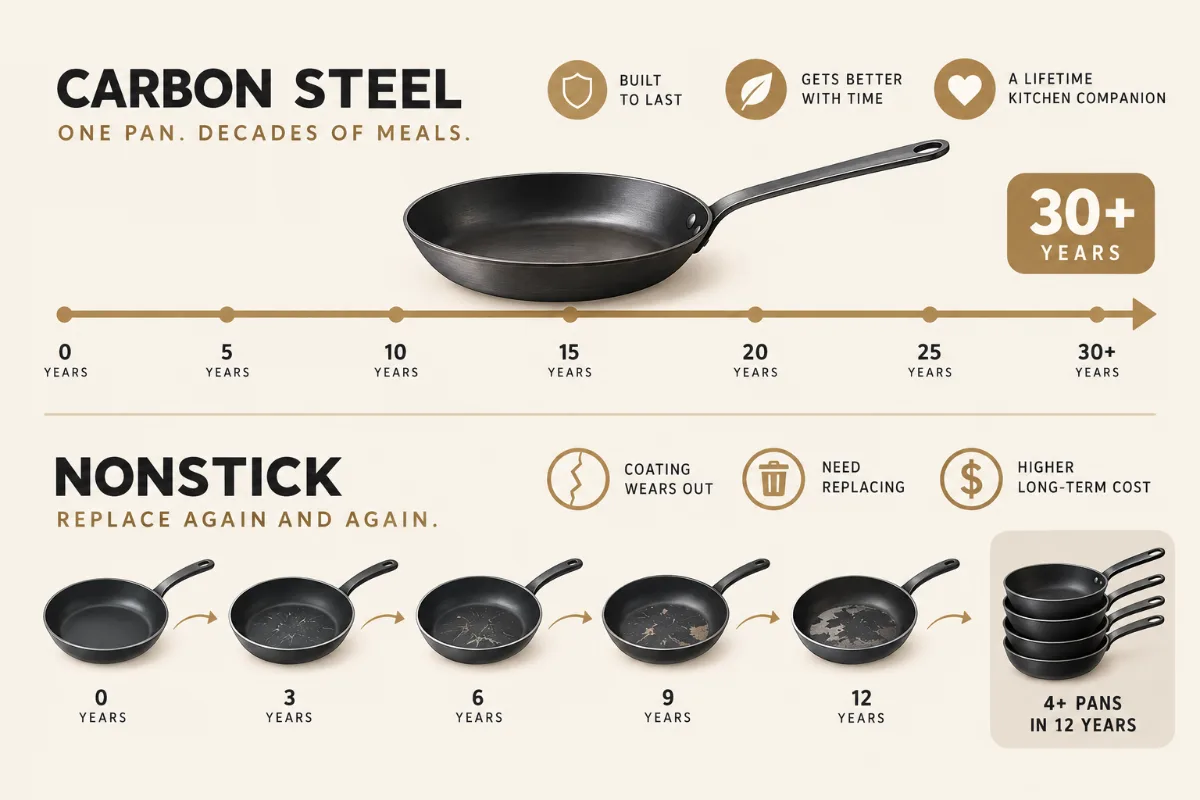
Carbon steel does not have a lifespan in the way a coated pan does. A nonstick pan is on a clock from the day you open it, because its slick surface is a coating that slowly breaks down with heat, metal tools, and scrubbing. Most last three to five years before they stop releasing food.
Carbon steel has nothing to break down. Its cooking surface is seasoning, a layer of oil polymerized onto bare metal, and that layer is renewable. When it thins or wears, you cook it back or re-season. The steel beneath is just steel, and steel does not expire. This is why cooks pass carbon steel and cast iron pans down through families while nonstick goes in the bin.
The word “last” also means something different for the two pans. A nonstick pan technically still exists after five years, but it no longer does its job, so its useful life is over. A carbon steel pan’s useful life and its physical life are the same thing, because the part that does the work can always be renewed. When you ask how long it lasts, the answer is how long you keep it, not how long before it stops working.
So the real question is not how long the pan lasts, but whether you will look after it. With basic care, the honest expectation is decades.
You do not have to take this on faith. America’s Test Kitchen and other longtime testers note that well-made carbon steel and cast iron pans routinely outlast the cooks who buy them, and antique shops are proof, stocked with hundred-year-old iron and steel pans that still cook once cleaned up. No one is selling a hundred-year-old nonstick pan, because none exists. The physical evidence for the lifespan is all around us.
Why carbon steel outlasts other pans
Three things give carbon steel its long life, and they all come back to the same idea: there is nothing on the pan that has a limited service life.
First, no coating. A coating is the part of any pan most likely to fail, and carbon steel simply does not have one. Nothing can flake, scratch off, or lose its slickness because the surface is bonded oil, not a factory-applied film.
Second, the seasoning is repairable. If the surface gets damaged, sticky, or worn, you rebuild it. You are never stuck with a degraded surface the way you are with a scratched nonstick pan. The pan resets to as good as new.
Third, the metal is solid and simple. There are no bonded layers to separate, no rivets that must hold a coating, nothing complex to fail. A carbon steel pan actually improves with age as the seasoning deepens, which is the opposite of how a coated pan behaves. Time makes it better, not worse.
Compare this to a clad or coated pan and the difference is stark. A nonstick pan can fail the moment its surface degrades, and there is no fixing it. A pan with glued or riveted layers can loosen over years of heat cycling. Carbon steel is a single piece of steel with a renewable oil surface, and simplicity is what makes it durable. Fewer parts means fewer things that can break.
What can actually end a pan’s life
To be complete, a few things can end a carbon steel pan, and knowing them lets you avoid all three.
Deep pitting rust is the main one. Surface rust wipes off and means nothing, but a pan left wet for a long time, or stored damp for months, can develop pits that eat into the metal. Caught early, rust is a quick fix. Left for a long time, deep pits can weaken the base. The prevention is simple: dry the pan and keep it lightly oiled.
Severe warping is the second. A badly warped base that rocks and heats unevenly can make a pan frustrating to use, especially on induction. This comes from thermal shock, not normal cooking, and it is largely avoidable by heating gradually and never shocking a hot pan with cold water. Our guide on how to care for a carbon steel pan covers the habits that prevent it.
A crack is the third and rarest. Carbon steel is tough, and a dropped pan almost never cracks the way brittle cast iron sometimes can. In normal home use, you will likely never see one.
Notice what is missing from that list. There is no mention of a coating wearing off, because there is none. There is no “the nonstick stopped working,” no “it started sticking after two years,” no scratched surface to worry about. The failure modes that retire most pans simply do not apply to carbon steel. What remains are three problems that all trace back to neglect or accident, not to the pan reaching some built-in end of life.
All three are preventable, and all three are rare. That is why the metal effectively outlives its owner.
The seasoning can always come back
Here is the point that makes the lifespan so long: even a pan that looks ruined can be brought back to life.
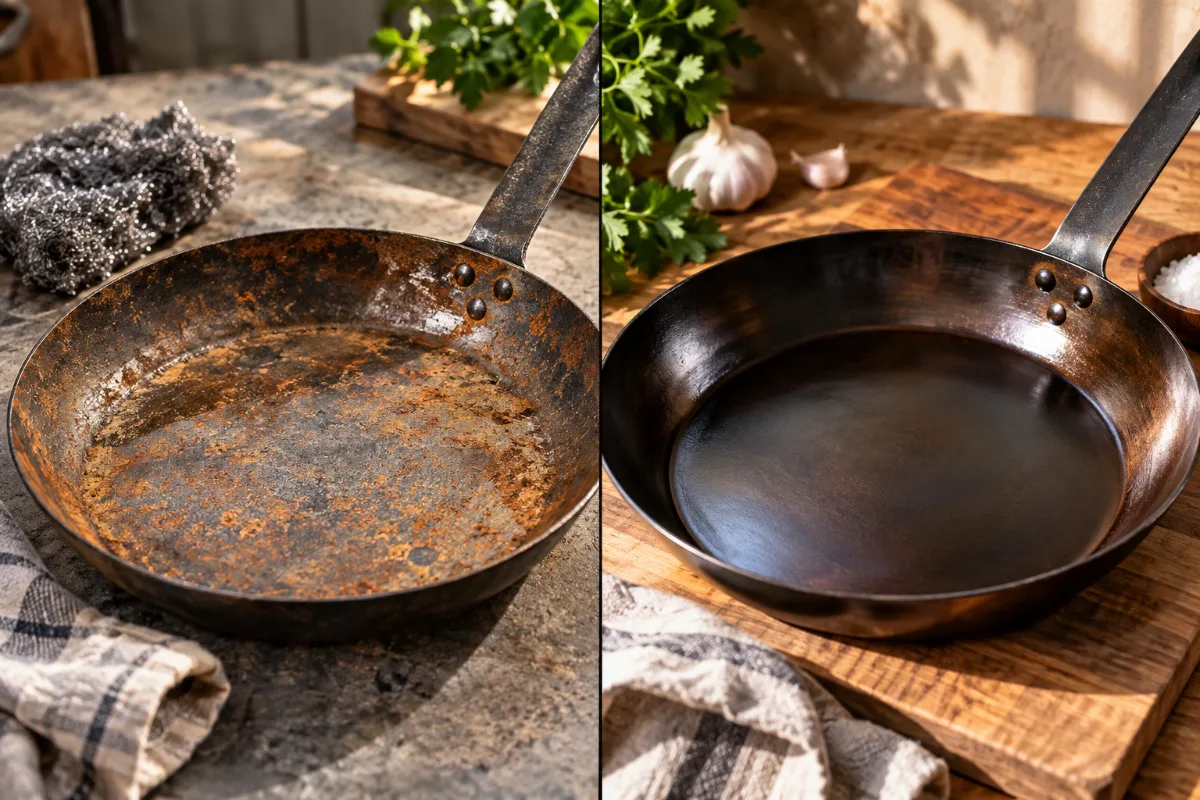
Say a pan sat in a garage and rusted, or came out of a dishwasher stripped and orange. It looks finished. It is not. Scrub the rust off with steel wool, wash the bare metal, dry it over heat, and lay down fresh seasoning. Within a session or two the pan cooks like it did when new. There is no equivalent recovery for a worn nonstick pan, which is simply thrown away.
This is why estate sales and thrift shops are full of decades-old carbon steel and cast iron pans that clean up beautifully. The surface is always recoverable because it was never a permanent coating in the first place. If you inherit or find a neglected pan, treat it as a project, not scrap.
The restoration itself is not complicated. For a rusty pan, you scrub the surface back to bare metal with steel wool or a stiff pad, wash and dry it thoroughly, then build fresh seasoning in thin layers. A pan that lost its seasoning to a dishwasher needs only the re-seasoning step. Either way you are working with the same metal the pan was born with, just resetting the surface. Our guide on how to care for a carbon steel pan covers the seasoning steps in detail. The point for lifespan is that “ruined” is almost never the right word for a carbon steel pan.
Cost per year versus nonstick
The lifespan turns into real money when you do the math.
Say a quality carbon steel pan costs more up front than a midrange nonstick pan. Used for thirty years, that carbon steel pan costs a few dollars per year of ownership. A nonstick pan replaced every four years, over the same thirty years, means buying seven or eight pans. Even at a lower price each, the running total climbs past the single carbon steel pan, and you have thrown seven pans away along the way.
The exact figures depend on what you buy, but the pattern holds every time: a pan that lasts decades has a very low cost per year, and a pan that lasts a few years does not. Add the waste of tossing coated pans repeatedly, and the case gets stronger.
There is a hidden cost to the nonstick cycle beyond money. Every replacement is a trip to the shop, a decision to make, and a worn pan sent to landfill. A coated pan also cooks worse in its final year than its first, so you spend months fighting a sticky, tired surface before you finally give up on it. Carbon steel runs the other way. It cooks at its worst on day one, before the seasoning builds, and steadily gets better. You are paying once for a surface that improves rather than paying again and again for one that decays.
Here is how the common materials compare.
| Cookware | Typical lifespan | Cost per year |
|---|---|---|
| Carbon steel | Decades / lifetime | Very low |
| Cast iron | Heirloom | Very low |
| Stainless | Decades | Low |
| Ceramic nonstick | 1–3 years | High |
| PTFE nonstick | 3–5 years | Moderate |
Quick answer: Our tested guide to how long do carbon steel pans last keeps it simple: master the technique, keep the surface seasoned, and match your heat to the food. The full method, the key facts and the mistakes to avoid are all below.
How Long Do Carbon Steel Pans Last: What Our Tests Found
Our team put how long do carbon steel pans last through repeated real cooking sessions to see what actually works. Below we break down the method, the facts that matter, and the common mistakes so you get reliable results the first time.
Making yours last a lifetime
Longevity is not automatic, but the care that delivers it takes seconds a day.
Dry the pan fully after every wash, ideally over heat, so no water sits on the metal to start rust. Keep a whisper-thin film of oil on the surface between uses to seal out moisture. Use the pan often, because a working pan stays seasoned and dry on its own. And heat it gradually rather than blasting a cold pan on high, which protects against warping.
That is the entire maintenance routine. Do it and the pan will very likely outlast the kitchen it lives in.
The best part is that using the pan is most of the care. A pan you cook in a few times a week stays warm, oiled, and dry through normal use, so the seasoning builds and rust never gets a foothold. The pans that die young are usually the ones that sit unused in a damp cupboard, not the ones on the stove every night. Regular cooking is both the reward and the maintenance, which makes the lifespan easy to reach without extra effort.
Treat the pan as a long-term tool rather than a disposable one, and it will reward that view for the rest of your cooking life. Few kitchen purchases can truly promise decades of service, and fewer still get better the more you use them.
For the fuller value picture, see whether carbon steel pans are worth it, and if you are ready to choose one built to last, start with our carbon steel frying pans guide.