
Cooking Surface vs Pan Size: The Number Nobody Advertises
Carbon steel pans are sold on rim diameter, but the flat base you actually cook on is often two to three inches smaller. An 11-inch pan may give you 8 inches of usable surface. This single number decides whether food browns or steams, and almost no listing puts it in the headline.
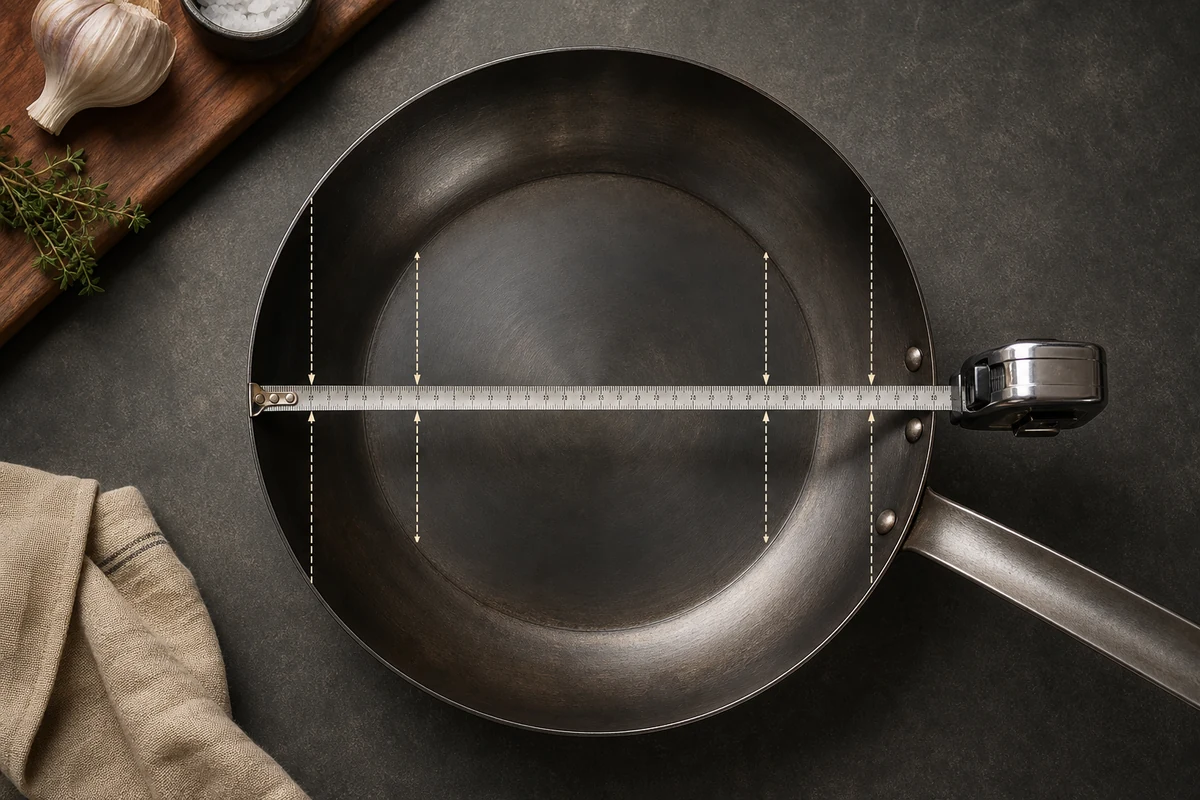
Why the gap exists
Carbon steel pans have sloping walls, which is what makes them good at tossing and at reducing sauces. But the slope has to start somewhere, and everything above that point is wall, not cooking surface. The steeper and taller the walls, the bigger the gap between advertised size and real estate.
The gap in real numbers
| Pan | Advertised | Cooking surface | Lost |
|---|---|---|---|
| Made In Seasoned | 10.25" | 7.5" | 2.75" |
| Matfer Bourgeat | 11" | 8" | 3" |
| de Buyer MINERAL B Pro | 11" | 8.3" | 2.7" |
| Matfer Bourgeat | 15.5" | 12" | 3.5" |
Roughly three inches vanishes on every pan in this category. That is consistent enough to use as a rule of thumb when a manufacturer does not publish the figure.
Why it matters more than you would expect
Browning requires contact between food and hot metal, and it requires space between the pieces. Crowd a pan and the moisture coming out of the food cannot evaporate fast enough, so the temperature at the surface drops and the food steams in its own liquid. You get grey meat instead of a crust.
The difference between 7.5 and 8.3 inches of cooking surface sounds trivial. In area it is about 20 percent, which is the difference between three chicken thighs browning properly and three chicken thighs steaming.
What size do you actually need
| Cooking for | Cooking surface needed | Look for a pan sold as |
|---|---|---|
| One person, eggs and small jobs | 5.5–6" | 8" |
| Two people | 7–8" | 10–11" |
| Three to four people | 9–10" | 12" |
| Batch cooking | 12"+ | 15"+ |
One more measurement to check
If you cook on induction, the flat base diameter also determines whether the hob detects the pan at all. A very small base may not register on some hobs regardless of the pan being ferrous.
Every pan in our frying pan comparison lists cooking surface where the manufacturer publishes it.
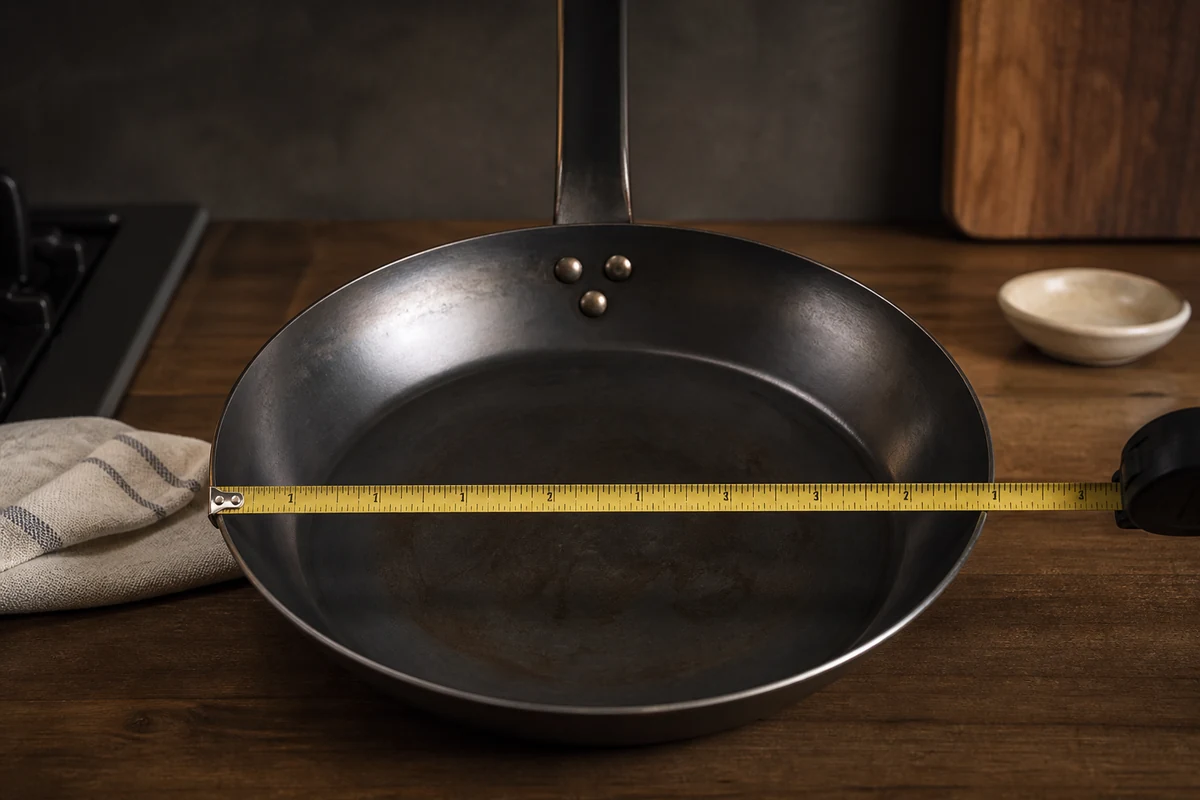
How to measure your own pan
Manufacturers publish rim diameter because it is the bigger number. You can get the real one in thirty seconds.
Turn the pan upside down and look at the base. On most carbon steel pans there is a visible ring where the flat bottom stops and the wall begins to curve. Measure across that ring, not across the rim. That measurement is your true cooking surface.
If the transition is hard to see, lay a straight edge across the base. The span where it makes full contact is the flat area. Anything beyond that is sloped wall, useful for tossing and for stopping splashes, useless for browning.
Why walls slope at all
It would be simple to make a pan with vertical walls and gain back those three inches. Manufacturers do not, for three reasons that matter more than the lost area.
Sloped walls let you slide a spatula underneath food without hitting a corner. They let you toss, which is the entire point of a carbon steel pan over a cast iron one. And they let steam escape, which is what stops a sear turning into a braise.
A straight-walled pan is called a saute pan, and it exists for exactly the jobs where those three advantages do not matter.
Cooking surface by pan type
| Shape | Wall angle | Surface lost | Why |
|---|---|---|---|
| Frying pan | Gentle slope | 2 to 3 inches | Tossing and spatula access |
| Saute pan | Near vertical | Under 1 inch | Maximum surface, no tossing |
| Wok | Steep slope | Half the diameter or more | Heat gradient is the point |
| Crepe pan | Almost flat | Under half an inch | Flipping thin batter |
| Griddle | None | None | All surface, no containment |
This is why a 13.5 inch wok has a 6.7 inch flat base and nobody complains. On a wok the slope is doing the work.
What crowding actually does
The reason this number matters is worth spelling out, because it is the difference between browned food and grey food.
Food releases moisture as it heats. On an uncrowded surface that moisture evaporates and the pan stays above browning temperature. Pack the pan and the moisture has nowhere to go, the surface temperature drops toward the boiling point of water, and the food steams in its own liquid.
You can see it happen. A crowded pan goes quiet and cloudy. An uncrowded one keeps sizzling. That difference is roughly twenty percent of usable area on an 11 inch pan, which is exactly the gap between rim and base.
Buying for the surface you need
The practical rule: add three inches to whatever cooking surface you actually want, then buy that size.
Two chicken breasts need about 8 inches of flat base, so buy an 11 inch pan. Four thighs need 9 to 10 inches, so buy a 12. A single steak is happy on 7 inches, so a 10 inch pan is enough. Our full comparison lists the published cooking surface for every pan where the manufacturer states it.
Buying by cooking surface, not by label
This is the spec that decides whether a pan is big enough, and almost nobody publishes it on the box. Two worked examples from our range: the Lodge 10 inch at $39.90 gives you roughly seven inches of flat base, while the Merten & Storck 12 inch at $59.99 gets you close to nine. That is a whole extra chicken breast. Our comparison table lists usable surface for every pan we carry.