Are Carbon Steel Pans Safe?
As an Amazon Associate I earn from qualifying purchases, at no extra cost to you.
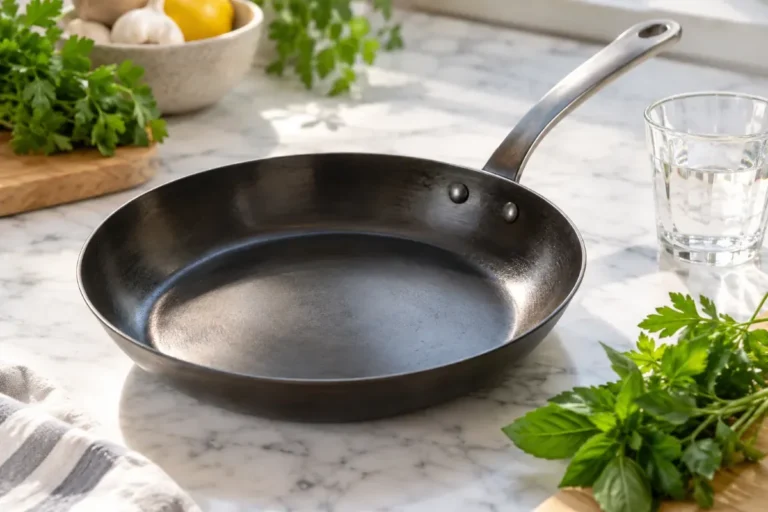
Uncoated carbon steel pans are considered safe for cooking. They contain no PFAS, PTFE or PFOA, and the main thing they transfer to food is a small amount of dietary iron. One documented exception exists: specific Matfer Bourgeat lots were recalled in France in 2024 after arsenic and chromium leached above EU limits.
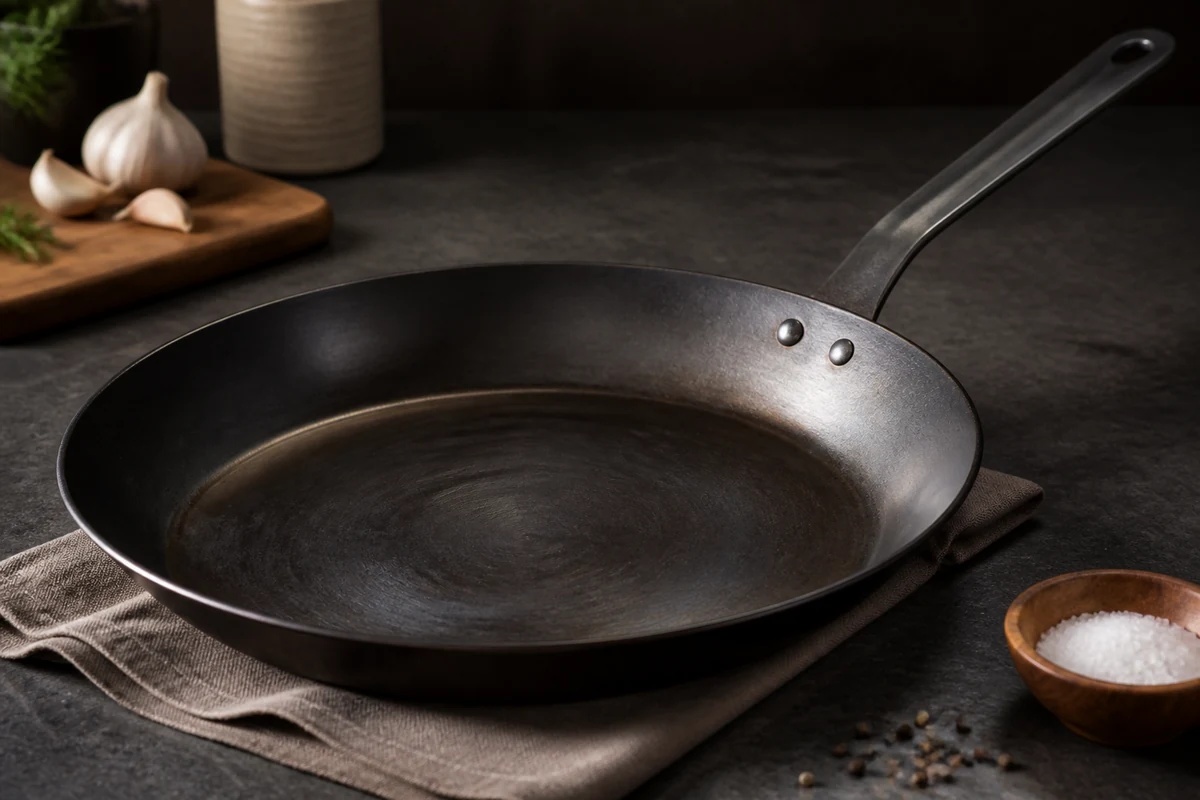
Quick answer: Our tested guide to carbon steel pans safe keeps it simple: master the technique, keep the surface seasoned, and match your heat to the food. The full method, the key facts and the mistakes to avoid are all below.
Carbon Steel Pans Safe: What Our Tests Found
Our team put carbon steel pans safe through repeated real cooking sessions to see what actually works. Below we break down the method, the facts that matter, and the common mistakes so you get reliable results the first time.
What is actually in a carbon steel pan
Roughly 99% iron and 1% carbon. That is the whole alloy in most cookware-grade carbon steel.
There is no coating on the cooking surface. No PTFE, the compound sold as Teflon. No PFOA, used historically in its manufacture. No PFAS more broadly, the class of persistent chemicals now driving most of the interest in this category.
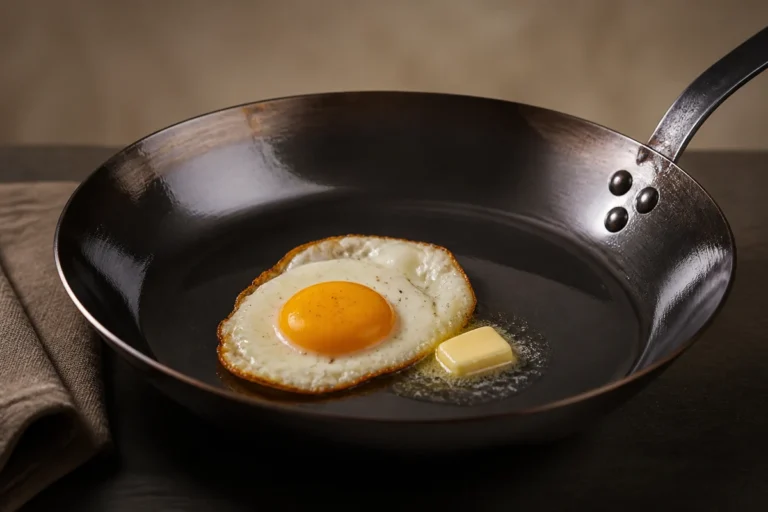
What sits on top is seasoning: polymerised cooking oil, chemically inert once formed.
Several manufacturers state this explicitly. Made In lists its carbon steel as made without PFAS, PFOA, PTFE, lead, cadmium, aluminium and BPA. Merten & Storck lists PFAS-free. Lodge lists no PFOA and no PTFE.
Iron transfer
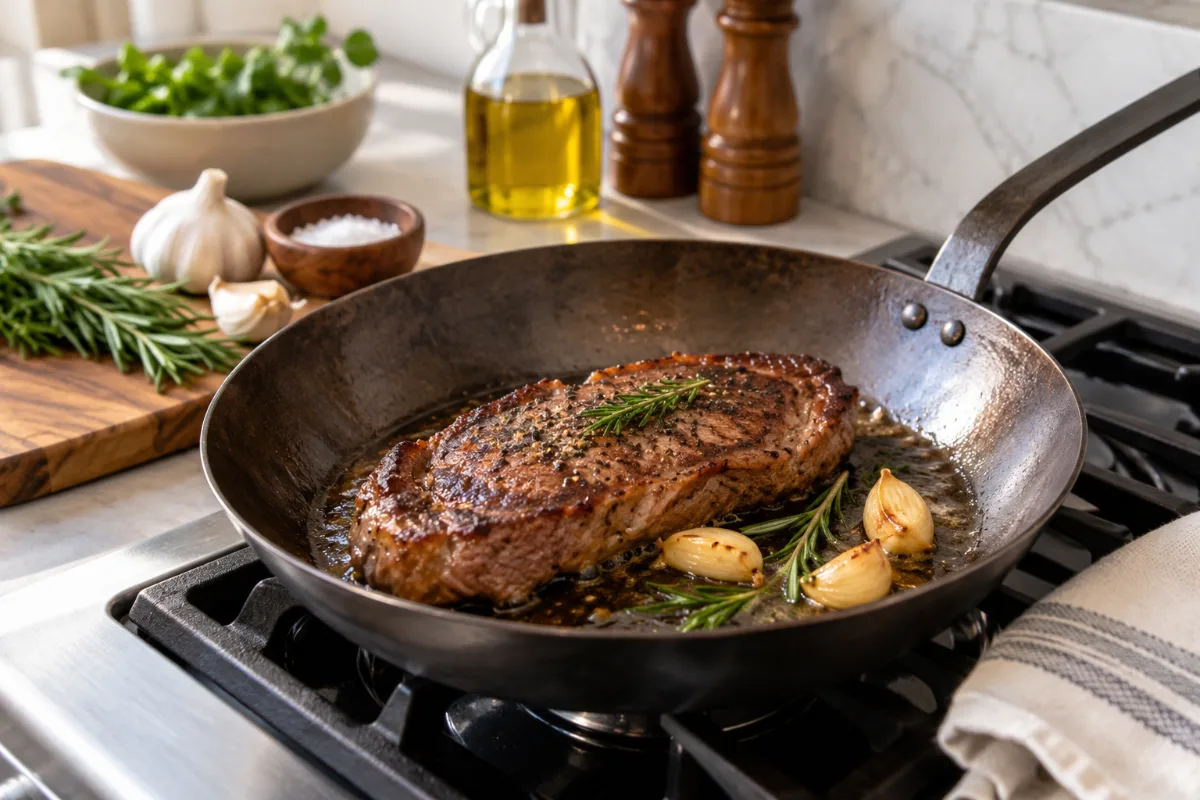
Cooking in carbon steel puts a small amount of iron into your food. This is well established and it is the same mechanism as cast iron.
For most people this is neutral to mildly beneficial, since dietary iron is a nutrient many diets are short of. Acidic food increases the transfer, which is one reason a long tomato simmer can pick up a metallic taste.
Two groups should be aware. People with haemochromatosis, a condition causing iron overload, are usually advised to avoid iron cookware. Anyone on iron-restricted medical advice should follow it. If either applies to you, ask your doctor rather than a cookware site.
The Matfer Bourgeat recall
This is the one documented safety finding in the category and it deserves plain treatment.
In April 2024, the DDPP of Isère, a French regional regulator, recalled specific lots of Matfer Bourgeat Black Steel skillets. Testing found arsenic, chromium and iron leaching above EU limits when a mild acidic solution was heated in pans from those batches.
Matfer has appealed and states its pans meet French and EU standards. The company argues the pans failed because they were tested unseasoned.
The pans were not recalled in the United States, and the reason is instructive. The EU sets numerical limits on metal release from cookware. The United States does not. America’s Test Kitchen, after months of investigation involving the FDA, EPA and CPSC, described US cookware safety as an honour system.
ATK withdrew its recommendation of the Matfer and has not restored it.
We sell both Matfer pans and earn commission on them. Full detail in our recall explainer, including affected lot numbers.
How carbon steel compares on safety
| Material | Coating | PFAS risk | Main consideration |
|---|---|---|---|
| Carbon steel | None | None | Iron transfer; one lot-specific recall |
| Cast iron | None | None | Iron transfer, higher than carbon steel |
| Stainless steel | None | None | Small nickel and chromium transfer |
| PTFE non-stick | Synthetic | Present | Degrades above about 500°F; coating wears |
| Ceramic non-stick | Synthetic | Varies by brand | Coating degrades within a few years |
The structural advantage of uncoated cookware is that there is no coating to break down, scratch into food, or off-gas when overheated.
Overheating
Carbon steel tolerates high heat well. Manufacturer claims vary: Made In states its pans are safe to 1200°F, while Lodge rates its carbon steel to 500°F. Both are manufacturer figures rather than independently verified.
An empty carbon steel pan left on a burner will discolour and can warp. It will not release fumes. A PTFE pan in the same situation can begin degrading above roughly 500°F, which is the practical safety difference between the two.
What to actually do
- Check Matfer lot numbers before buying, or choose a different brand.
- Keep acid out. This reduces metal transfer and protects your seasoning.
- Build proper seasoning. A mature layer is a physical barrier between food and bare steel.
- Do not cook on visible rust. Clean it first.
- Ask your doctor if you have haemochromatosis or are on iron-restricted advice.
What the science actually measures
Cookware safety claims get thrown around loosely, so it helps to know what regulators and labs actually test.
The standard test is migration: heat a mildly acidic solution in the pan and measure which metals move into the liquid, in what quantities. The European Union publishes limits for each metal. The United States, as covered above, publishes none for cookware specifically, which is why the Matfer recall could happen in France and not here.
For uncoated carbon steel, the metals in question are iron, plus whatever trace elements ride along in the alloy. Cookware-grade carbon steel is a simple recipe, roughly 99% iron and 1% carbon, and in a properly made pan the trace elements sit far below any limit. The French finding against specific Matfer lots was significant precisely because it was unusual.
Iron transfer, with actual numbers
Studies of iron cookware consistently show measurable transfer, and the amounts depend on three things: acidity, cooking time and the age of the seasoning. Long-simmered acidic food in a new pan transfers the most. A quick sear in a mature pan transfers very little, because polymerised seasoning is a physical barrier between food and metal.
For context, adult daily iron needs run around 8mg for men and 18mg for menstruating women, and iron cookware typically contributes a fraction of a milligram to a few milligrams per serving depending on the dish. Public health programmes in several countries have actually used iron cookware deliberately as a supplementation strategy.
The flip side is genuine: people with haemochromatosis absorb and store iron they cannot shed, and iron cookware works against them. This is the one population for whom the material is a real consideration rather than a footnote.
Seasoning safety, since you will be asked
The layer you cook on is polymerised oil. Is that safe?
Polymerisation is the same chemistry that dries oil paint and hardens linseed-oiled wood. The result is chemically inert, insoluble in water and stable at cooking temperatures well beyond anything a kitchen produces. It does not migrate into food the way a degrading synthetic coating can, because there is nothing mobile left in it.
The honest caveats are practical rather than chemical. Seasoning built from rancid oil smells and tastes bad, though it is not dangerous. And loose carbon flakes from thick failing seasoning are unpleasant in food, again without being a health hazard. Both are maintenance problems with maintenance fixes.
Comparing the actual failure modes
Every cookware material has a way of going wrong. The useful comparison is what failure looks like.
| Material | How it fails | What reaches your food | Fixable? |
|---|---|---|---|
| Carbon steel | Rust, flaking seasoning | Iron oxide, carbon flakes | Fully, by reseasoning |
| Cast iron | Same as carbon steel | Same | Fully |
| Stainless | Pitting from salt, rare | Trace nickel, chromium | Mostly cosmetic |
| PTFE non-stick | Scratching, overheating | Coating particles, fumes past 500°F | No, replace the pan |
| Ceramic non-stick | Coating wears out | Generally inert particles | No, replace the pan |
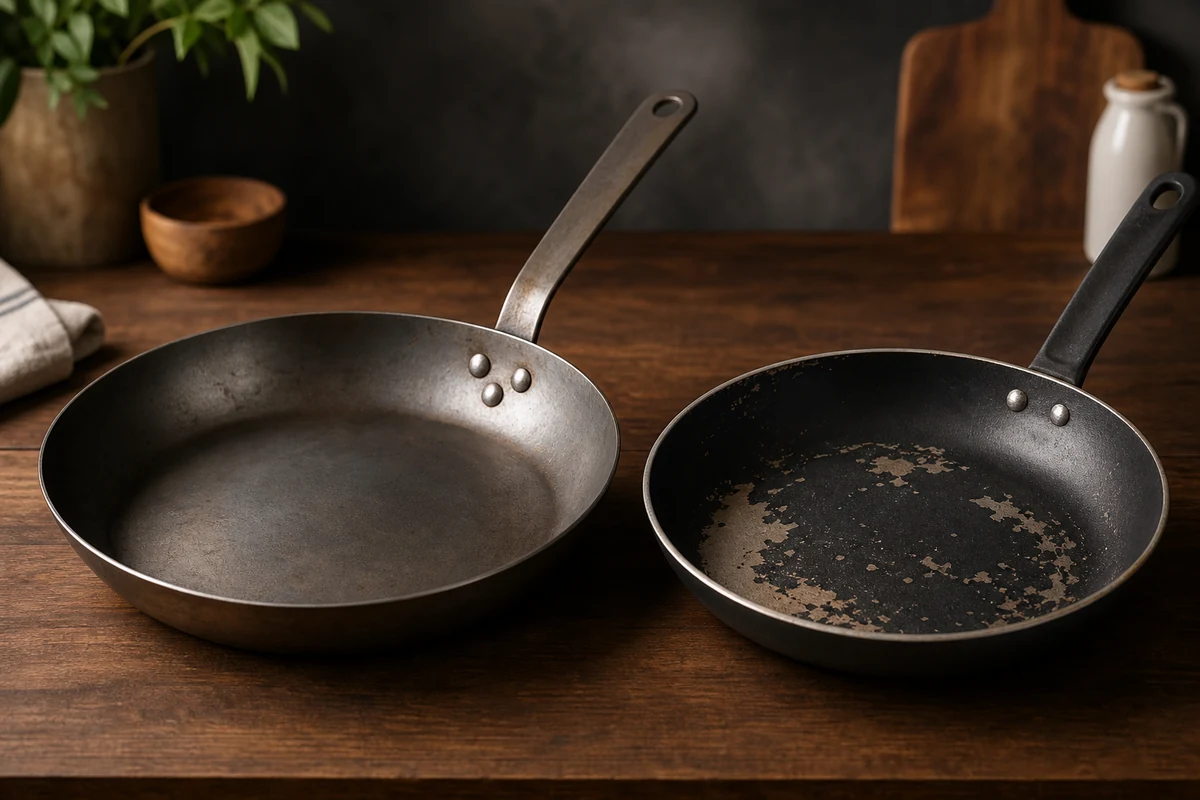
The pattern worth noticing: uncoated failures are reversible and their by-products are the same iron your diet already contains. Coated failures are terminal and shed synthetic material. That asymmetry, more than any single study, is the case for uncoated cookware.
Questions your family will ask
Is the black stuff coming off dangerous? It is carbon from seasoning, not a synthetic coating. Not a health issue, but scrub and reseason because it means a layer is failing.
Can I cook for a baby in it? Uncoated steel is a reasonable choice for family cooking. The iron contribution is if anything useful at weaning age. Ask your paediatrician if iron intake is medically managed.
Is rust poisonous? Small amounts of iron oxide are not considered harmful, which is why a rusted pan is recoverable rather than wasted. Clean it off before cooking because it tastes bad and signals unprotected metal.
Why did France recall a pan the US did not? Because the EU has numeric limits and a testing regime, and the US does not. Same pan, different rulebook. The full story is in the recall explainer.
What we recommend, and what we do not
Uncoated steel contains no PFAS and transfers a small amount of dietary iron. That is the whole story for twelve of the fourteen pans we list. The exception is Matfer Bourgeat, subject to a recall we report rather than bury, on pages that earn us commission. Money we would spend instead goes to the Mauviel M’Steel 11 inch at $120 or the de Buyer MINERAL B Pro at $99.95.
Frequently asked questions
Are carbon steel pans safe to cook with?
Do carbon steel pans contain PFAS?
Does carbon steel leach iron into food?
Is the Matfer Bourgeat recall a reason to avoid carbon steel?
Is carbon steel safer than non-stick?
Sources: America’s Test Kitchen investigation, 27 August 2024; DDPP of Isère recall notice, April 2024; manufacturer product listings. This is general information, not medical advice. Last checked 22 July 2026.