Carbon Steel Pan Warping: Why It Happens and How to Prevent It
By the Carbon Steel Pan test team · Last updated September 2026
Carbon steel warps from thermal shock: heating a thin pan fast and unevenly, or adding cold liquid to a very hot pan. The sudden temperature difference makes the metal expand or contract in one area faster than another, and it deforms. Thinner pans warp more easily. Heat gradually, match the pan to the burner, and skip cold shocks, and warping stays rare.
What warping looks and feels like
Before you diagnose the cause, confirm you are actually dealing with a warped pan. The signs are easy to spot once you know them.
The clearest test is to set the pan on a flat countertop and press one edge. A flat pan sits still. A warped one rocks, or spins like a coin when you nudge it. On an induction hob a warped base may wobble or buzz because it no longer sits fully on the surface.
You will also see it while cooking. Oil runs to one side and pools instead of coating the center. Eggs slide downhill. Heat comes through unevenly, browning one zone while another stays pale. A dome in the middle, called an oil-canning bulge, makes butter creep to the rim. If any of that sounds familiar, the base has lost its true flat shape.
It is worth confirming the warp is real before you act, because a pan can seem to wobble for other reasons. A bit of stuck-on debris or a warped burner grate can mimic the symptom. Clean the base, set the pan on a known-flat surface like a glass cutting board or a countertop, and look for daylight under the edges or a rock when you press. If it sits dead flat there, the pan is fine and the problem is elsewhere. Only a base that clearly rocks or domes counts as warped.
Quick answer: Our tested guide to carbon steel pan warping keeps it simple: master the technique, keep the surface seasoned, and match your heat to the food. The full method, the key facts and the mistakes to avoid are all below.
Carbon Steel Pan Warping: What Our Tests Found
Our team put carbon steel pan warping through repeated real cooking sessions to see what actually works. Below we break down the method, the facts that matter, and the common mistakes so you get reliable results the first time.
Why carbon steel warps
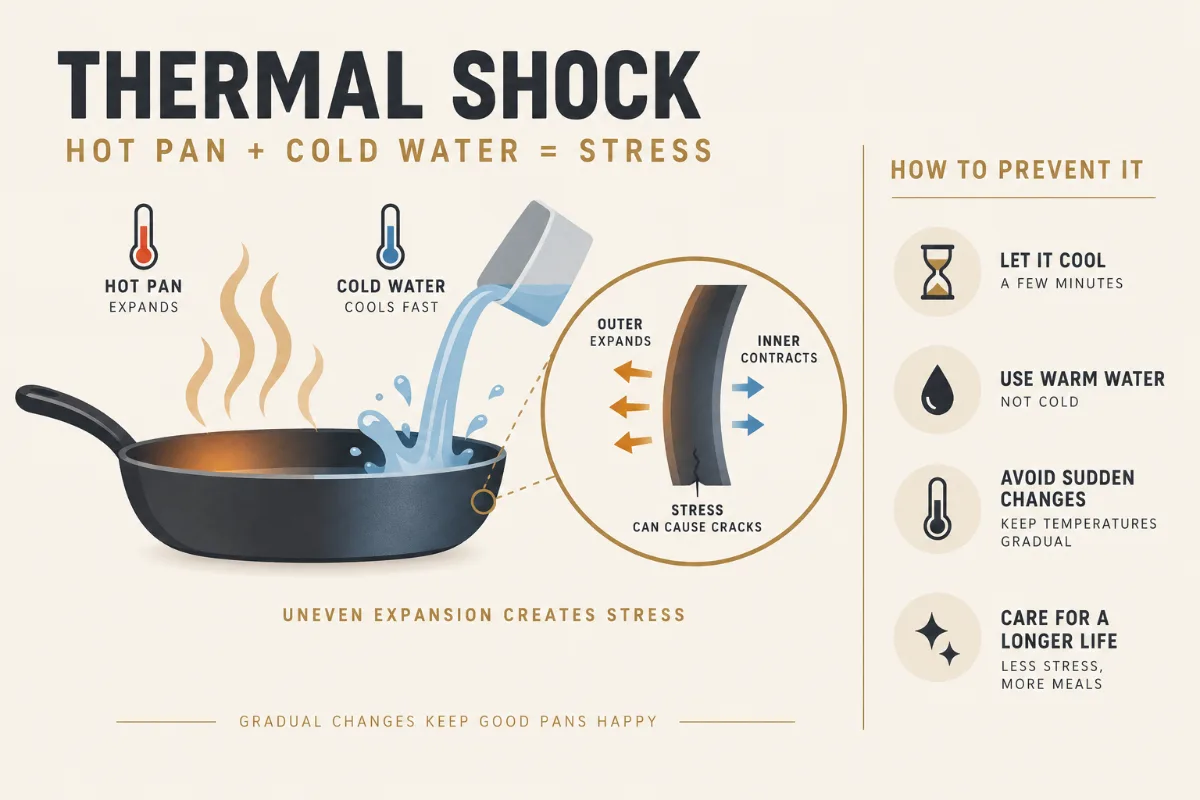
Metal expands when it heats and contracts when it cools. That is normal and harmless when it happens evenly across the whole pan. Warping happens when one part changes temperature much faster than the part next to it. The hot region grows while the cooler region holds still, the metal is forced to bend, and past a certain point it stays bent. This is thermal shock, and it has three common triggers.
Uneven or rapid heating
Blast a pan on high from cold and the metal touching the flame shoots up in temperature while the rest lags. That gap stresses the pan. Thin carbon steel heats so fast that the difference builds in seconds. A gradual preheat lets the whole base climb together, which is why patience matters more here than with a thick, slow cast iron pan.
Cold shock
This is the classic mistake. You finish a hard sear, the pan is screaming hot, and you deglaze with cold water or drop the pan in the sink to rinse. The surface that meets the cold liquid contracts instantly while the rest stays expanded. The pull is violent enough to snap a thin base out of shape in one move. More warped pans come from this than from any other single cause.
Wrong burner size
A burner smaller than the pan concentrates all the heat in the center while the edges stay relatively cool. That builds a permanent hot center and cool rim, and over many cooks the center can bulge. Matching the flame to the base spreads the heat and removes the stress.
Thin gauge amplifies every one of these. A light pan has less metal to absorb and even out the temperature difference, so it gives way sooner than a heavier one.
It helps to picture the metal in motion. Steel expands roughly in proportion to how much its temperature rises. When the center of the base is 200 degrees hotter than the rim, the center wants to grow while the rim holds it back. That tug creates internal stress. Below a certain point the metal springs back when it cools, which is why a pan can flex and recover many times without harm. Push the gap too far, too fast, and the stress passes the point of no return. The metal yields and keeps the new shape. Everything about prevention comes down to keeping that temperature gap small: heat slowly, spread the heat, and never introduce a sudden cold hit.
Does gauge and thickness matter?
Yes, and it is the biggest built-in factor. Gauge is the thickness of the steel. A thicker pan holds more metal, spreads heat more evenly, and resists the bending force of a temperature gap. A thin pan does the opposite.
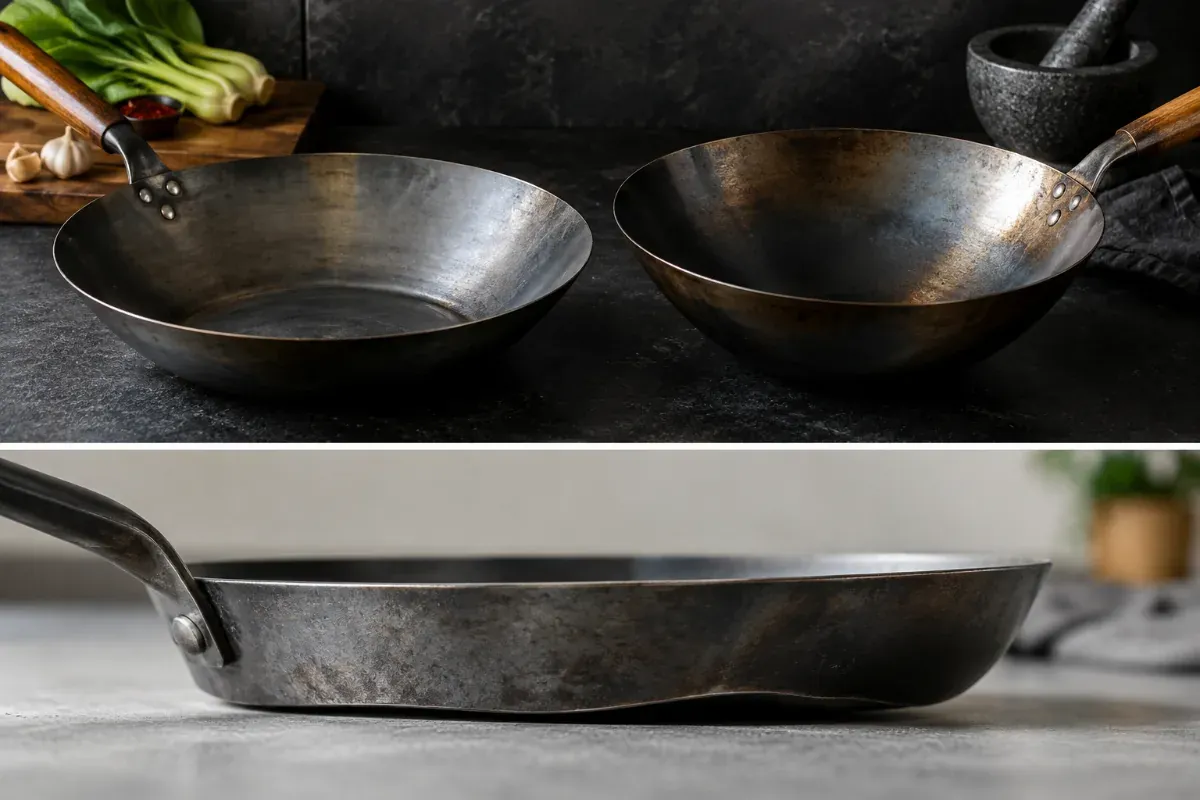
The trade-off is weight and speed. Thin pans heat fast, cool fast, and are light enough to toss for stir-frying, which is exactly why lightweight woks are thin. Thicker pans are heavier and slower to respond but far more stable under high heat. Many quality skillets land around 2 to 3 mm at the base as a balance (verify against the specific brand).
If you cook at very high heat often, or you are hard on your gear, lean toward a heavier gauge. If you want an easy-to-lift everyday pan and you cook with a gentler hand, a lighter pan is fine as long as you respect the heating rules. Our carbon steel gauge and thickness guide (planned) breaks the numbers down by use.
Construction beyond gauge matters too. Pans with a spun or stamped base of even thickness resist warping better than ones with thin spots. A rolled rim adds rigidity to the edge, which helps the whole pan hold its shape. None of this shows up in a marketing photo, so weight in the hand and a flat sit on the counter are your best in-store checks. A pan that already rocks slightly on the shelf will not improve with cooking.
Can you fix a warped pan?
Sometimes, partially, but set your expectations. A slight warp can occasionally be coaxed back. A severe one usually cannot, and forcing it risks cracking the metal or the seasoning.
The gentle approach is heat and careful pressure. Warm the pan slowly and evenly, then, with it supported and protected, apply steady pressure to the high point, or tap a raised center down against a firm flat surface with a mallet through a cloth. Work in small increments and check often. Results vary a lot with the pan and the damage, and there is real risk of making it worse.
One repair path to avoid is grinding or hammering the seasoned surface flat with force. That cracks the seasoning, gouges the metal, and often trades a small warp for a scarred pan. If you attempt a fix at all, work with heat and patient, even pressure, and accept that you may only improve the warp rather than erase it.
We say this plainly because it is true: prevention beats repair every time. A warped pan is far easier to avoid than to correct. If a pan is only mildly warped, it may be simpler to keep using it on gas, where a small dome matters little, than to gamble on a fix. Reserve repair attempts for pans you would otherwise retire.
How to prevent warping (steps)
Warping is almost entirely preventable with a few habits. Build these in and it stops being a worry.
- Preheat gradually. Start on low to medium and give the pan two to three minutes to come up before you push the heat higher. Never start a cold thin pan on full blast.
- Match the burner to the base. Use a burner close to the pan’s diameter so heat spreads across the whole base instead of concentrating in the center.
- Never shock a hot pan with cold. Let the pan cool before you rinse it, and deglaze with room-temperature or warm liquid, not straight-from-the-tap cold water.
- Let it cool before washing. Carry the pan off the heat and give it a few minutes. A pan that is merely warm, not blazing, tolerates water without stress.
- Do not slam or drop a hot, heavy pan onto a cold surface, which adds mechanical stress to thermal stress.
Follow those and you remove every common trigger at once. Our guide to how to use a carbon steel pan covers the same heat discipline in the wider context of daily cooking.
Warping on induction specifically
Induction deserves its own note because it warps pans more readily than gas does. Induction heats only the metal directly over the coil, not the air around it, so the heat is intense and concentrated in the contact zone. If the base is thin or does not fully cover the induction ring, the center can run far hotter than the edges and bow.
Two rules keep an induction cook safe. First, use a pan whose flat base matches or exceeds the induction zone so the heat has a full disc to spread through. Second, use the same gradual preheat you would on gas, and resist the temptation to run maximum power under an empty pan. A heavier-gauge pan is a smart choice for induction for this reason. We go deeper in the carbon steel induction guide (planned), including which bases sit best on a glass surface.
Many induction hobs offer a boost or power-level setting, and it is a common warping trap. Boost dumps maximum energy into the base almost instantly, which is exactly the rapid, concentrated heating that bows a thin pan. Save boost for boiling a pot of water, not for preheating a skillet. Bring a carbon steel pan up on a moderate level, let it settle, and only then raise the heat if a dish needs it. A little restraint at the dial prevents the damage the hob is otherwise happy to cause.
Here is the quick reference for causes and prevention.
| Cause | Why it warps | Prevention |
|---|---|---|
| Rapid high heat | Uneven expansion | Preheat gradually |
| Cold water on hot pan | Sudden contraction | Let the pan cool first |
| Burner smaller than base | Center hot, edges cold | Match pan to burner |
| Thin gauge | Less resistance | Choose heavier gauge for high heat |
Frequently asked questions
Why did my carbon steel pan warp?
Can you fix a warped carbon steel pan?
Does thicker carbon steel warp less?
How do I stop my pan warping on induction?
Is a slightly warped pan still usable?
The takeaway
Warping is not a sign of a bad pan. It is a sign of a fast temperature swing the metal could not absorb. Heat the pan up slowly, keep the flame under the base, and never hit hot steel with cold water, and you sidestep nearly every case. If you are still shopping, weigh gauge against weight for the way you cook, and consider how the base will sit on your hob. The details on handle construction and build quality live in our notes on riveted vs welded handles.