Does Carbon Steel Have PFAS or Teflon? A Straight Answer
By the Carbon Steel Pan test team · Last updated September 2026
No. Carbon steel contains no PFAS, PTFE (Teflon), or PFOA. Those chemicals belong to synthetic nonstick coatings, and a carbon steel pan has no coating on it at all. Its slick surface is seasoning, a thin layer of oil hardened onto bare metal by heat. There is nothing chemical to flake, scratch, or leach.
The one-word answer
No. If you searched this out of worry, you can relax now. A carbon steel pan is bare metal, and bare metal cannot hold a coating that was never applied to it. The dark, slippery surface you see is not sprayed on in a factory. It forms in your own kitchen from oil and heat. So the answer to does carbon steel have PFAS is a clean no, and the rest of this page explains why that holds up.
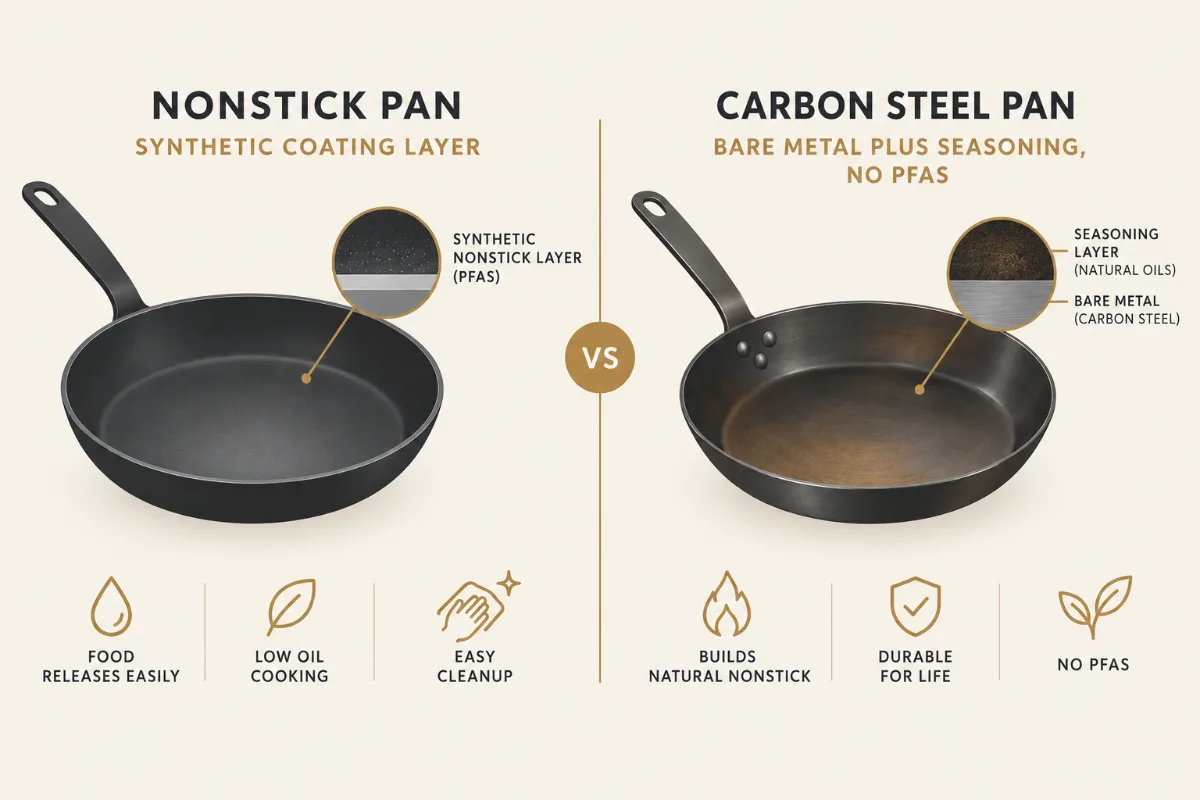
The confusion is understandable. Carbon steel behaves like a nonstick pan once it is broken in, and anything that releases food easily gets lumped in with the coated pans people are trying to avoid. But how a surface performs and what it is made of are two separate things. A seasoned pan can be slick and completely coating-free at the same time. That is the crux of the whole answer.
What PFAS, PTFE and Teflon actually are
These names get thrown around together, so here is the plain version.
PFAS stands for per- and polyfluoroalkyl substances. They are a large family of man-made chemicals valued for resisting heat, oil, and water. Because they break down very slowly in the body and the environment, people call them forever chemicals.
PTFE is one specific PFAS. Teflon is simply a brand name for PTFE. When a pan is sold as “nonstick,” the slick feel almost always comes from a thin PTFE film baked onto the metal.
PFOA was a processing aid once used to make PTFE. Manufacturers in the United States phased it out of nonstick production years ago, according to the U.S. Food and Drug Administration, though it left a lasting reputation.
Notice the common thread. Every one of these is a coating or coating chemistry. They are polymers and processing aids, not metals. A frying pan can carry them only if a synthetic layer was applied to its surface during manufacturing. This single fact is why a bare metal pan sits in a different category entirely.
It helps to understand why the worry exists at all. The concern with PTFE cookware is not that a pan in your cupboard is leaking chemicals into the air. It is that an overheated or badly scratched nonstick surface can shed particles or release fumes as the coating breaks down. Empty a nonstick pan on high heat for long enough and the film can degrade. Gouge it with a metal spatula and flakes can lift into food. Both problems are properties of a coating. Take the coating away and both problems vanish. That is the logic that puts carbon steel on the safe side of the line.
Why carbon steel has none of them
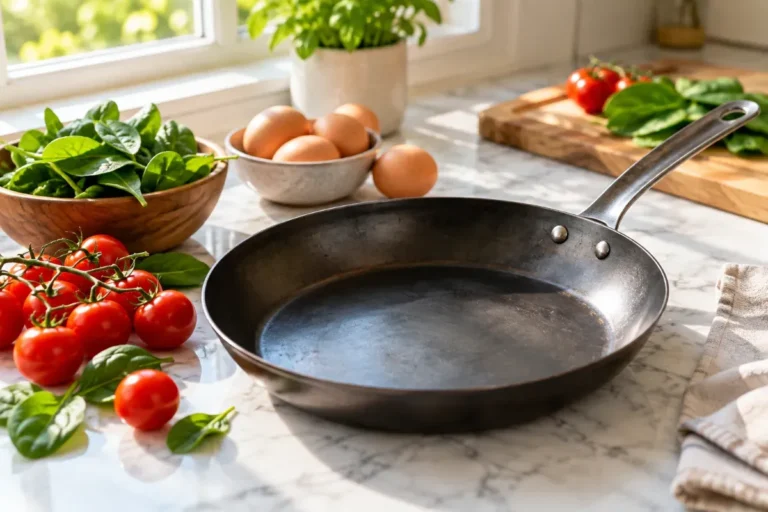
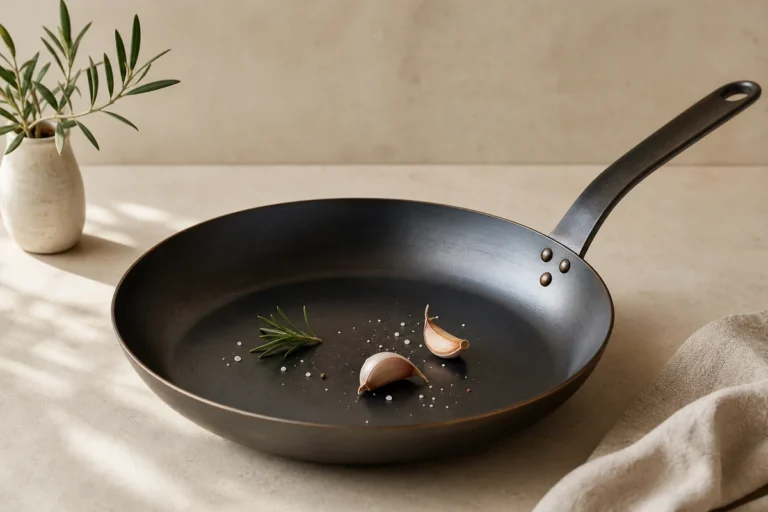
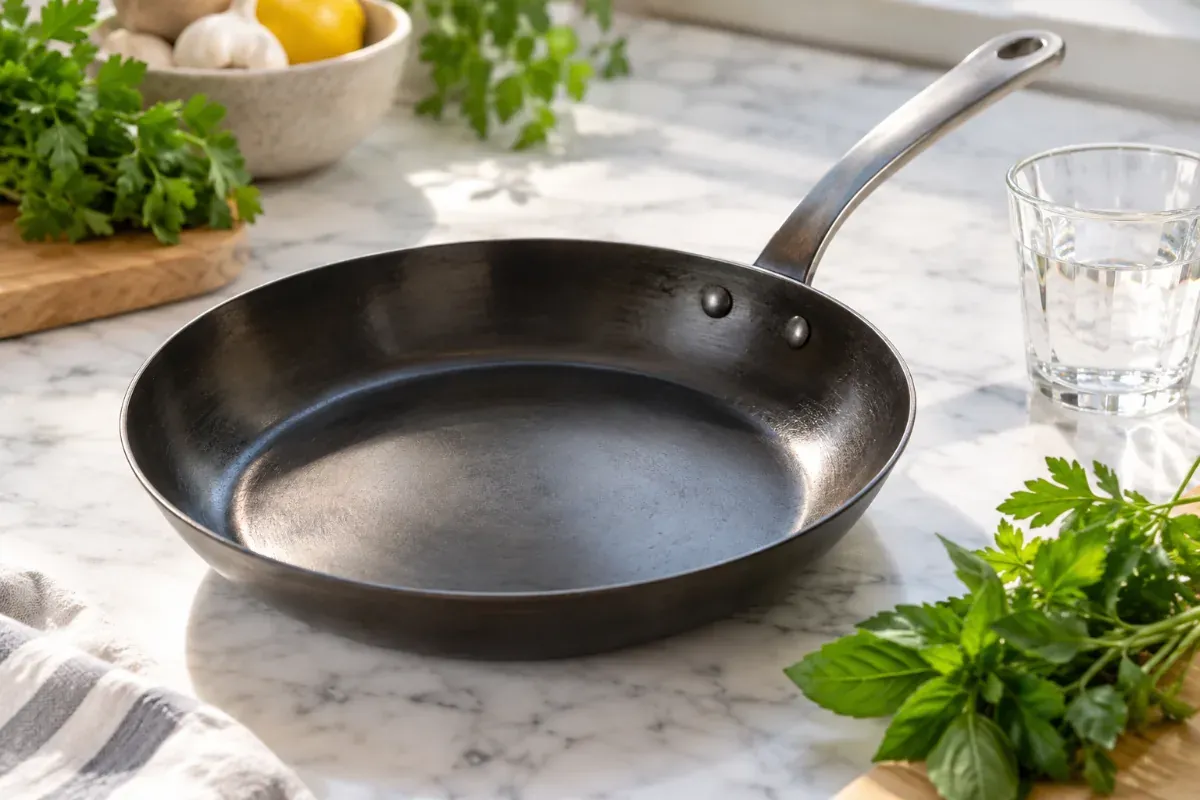
Carbon steel is an alloy of iron and a small amount of carbon. That is the whole pan. When it leaves the factory, it is raw, gray metal, sometimes with a light protective film to stop rust in the box (more on that below).
No plant sprays a nonstick layer onto it. No PTFE film gets baked into the surface. There is no coating step in making one of these pans, so there is no place for PFAS to hide. You are cooking on iron.
The dark color that develops looks like a coating to the eye, and that is where the confusion starts. People assume anything nonstick must have “the nonstick chemical” on it. But the darkness on a well-used pan is seasoning, built up in your kitchen from the fats you cook with. It was never manufactured, shipped, or applied as a treatment. The Environmental Working Group, which tracks PFAS in consumer goods closely, ties the concern to coated nonstick cookware, not to bare cast iron or carbon steel.
How carbon steel gets nonstick without chemicals
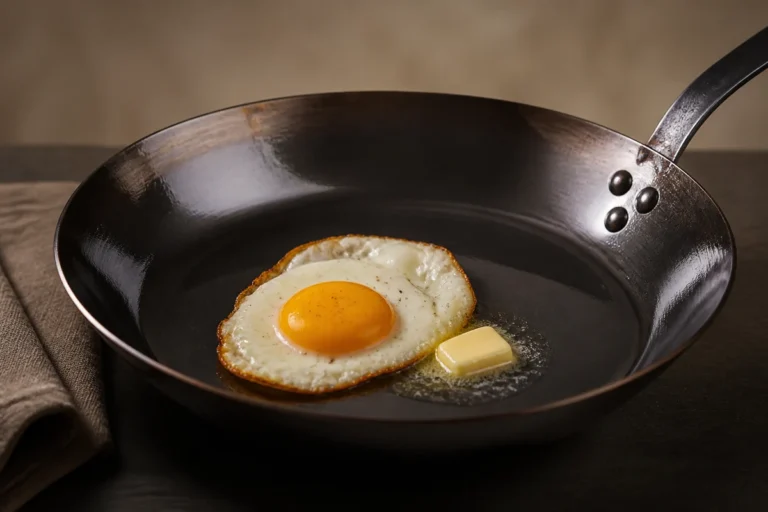
If there is no coating, why does an egg slide right off a seasoned pan? The answer is a process called polymerization.
When you heat a very thin film of oil in the pan, the oil does not just dry. Heat rearranges it into a hard, smooth, plastic-like layer that bonds to the metal. This layer is not liquid oil and it is not raw fat. It is a cured, food-safe film, and it is what makes the surface release food.
Cast iron owners will recognize this instantly, because it is the same idea. Both metals build their nonstick surface the same way, layer by layer, through cooking and the occasional deliberate seasoning session. The more you use the pan, the slicker it gets.
So the “nonstick” of carbon steel is earned, not applied. It comes from oil and heat, two things already in your kitchen, rather than from a fluoropolymer sprayed on before you ever saw the pan.
The seasoning layer is also tougher than most people expect. Because it is bonded to the metal and made of the same fats you already eat, it does not have a “wear-out” date the way a factory coating does. If it thins or gets damaged, you simply cook more or re-season, and it builds right back. There is no point where you throw the pan out because the nonstick “expired.” That durability is a direct result of there being no manufactured coating to fail in the first place.
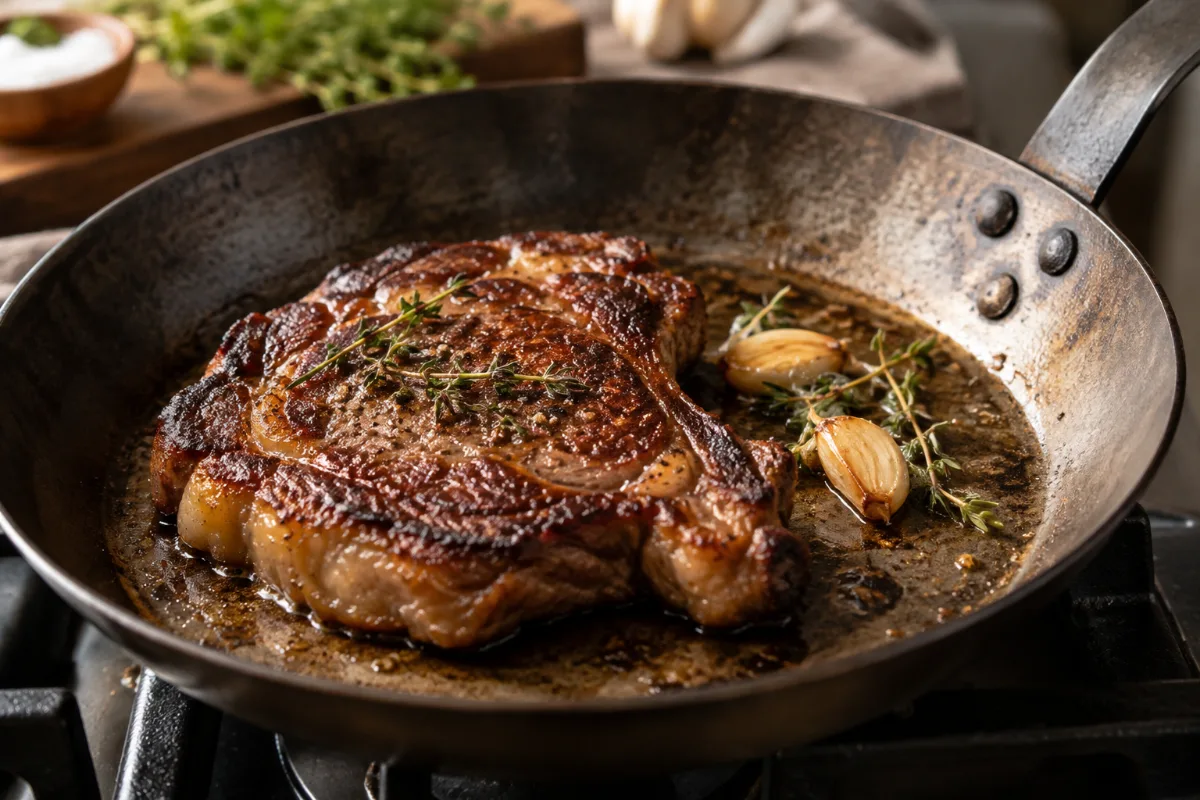
Quick answer: Our tested guide to carbon steel have pfas keeps it simple: master the technique, keep the surface seasoned, and match your heat to the food. The full method, the key facts and the mistakes to avoid are all below.
Carbon Steel Have Pfas: What Our Tests Found
Our team put carbon steel have pfas through repeated real cooking sessions to see what actually works. Below we break down the method, the facts that matter, and the common mistakes so you get reliable results the first time.
The one exception to check: factory coatings
Here is the honest nuance, because a good answer does not hide the details.
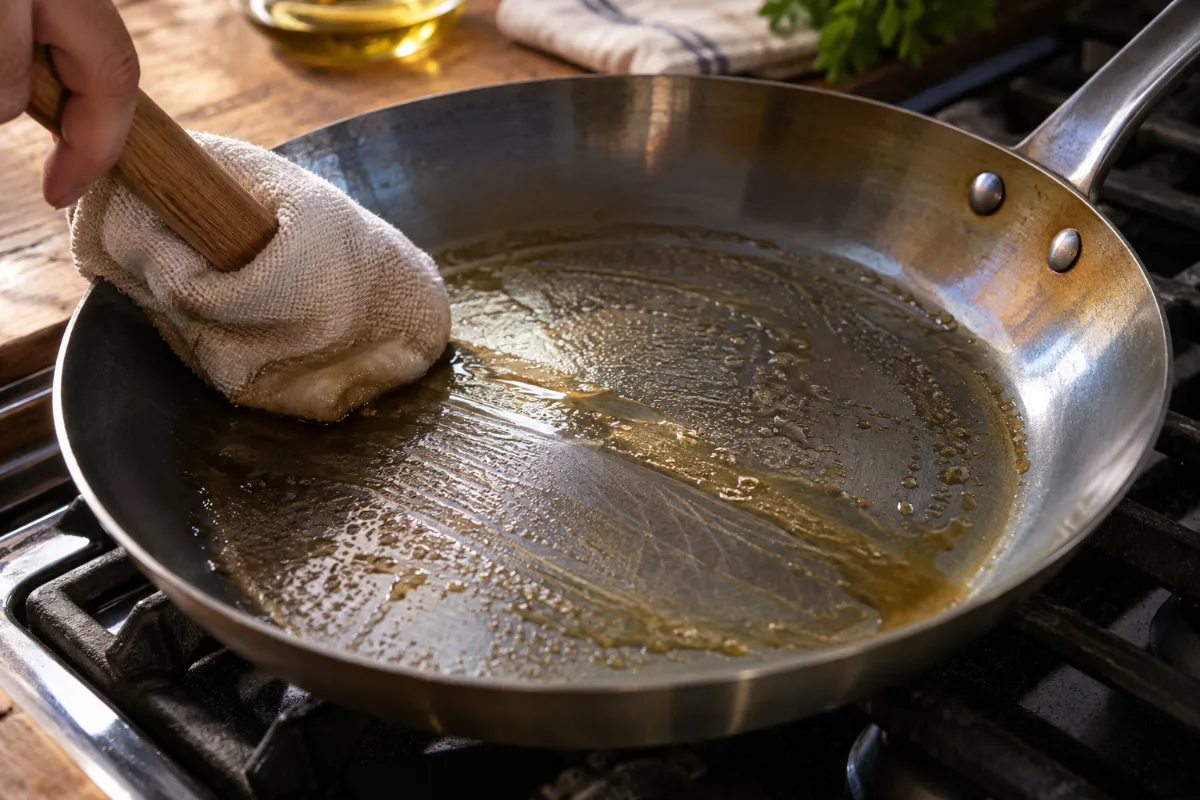
Some new pans do arrive with something on the surface, and it pays to know what it is. Brands like de Buyer ship their pans with a thin beeswax film. This is not nonstick treatment. It is a rust barrier that protects the raw steel while the pan sits in a warehouse and travels to you.
You wash it off before the first use. Warm water, a little soap, and a scrub take it right off, and then you season the pan for the first time. That beeswax is a natural wax, not a fluorinated chemical. It has nothing in common with PFAS or PTFE.
Other brands, such as many Lodge and Mineral B pans, come lightly pre-seasoned with oil rather than waxed. Either way, check the maker’s care page for your specific pan so you know whether to strip a wax film or start seasoning straight away. Nothing in that step involves a synthetic coating.
If you want to be certain about a specific pan, the maker’s own care instructions are the fastest check. A page that says “remove the protective beeswax coating” or “wash off the light factory oil before first use” is describing a natural rust barrier, not nonstick treatment. What you will not find on a real carbon steel pan is any instruction about a nonstick coating, because there is none to describe. The absence of that language is itself a good sign.
Does high heat change anything?
A fair question, since carbon steel is famous for getting extremely hot, and heat is exactly what damages a nonstick coating. Here the difference works in your favor.
The reason high heat threatens a Teflon pan is that the coating starts to break down past a certain temperature. Carbon steel has no coating, so there is nothing to break down. You can crank it to searing heat, put it under the broiler, or slide it into a hot oven, and the metal simply gets hot. The seasoning may darken or need a touch-up over time, but seasoning is food-grade fat, not a chemical film. Nothing hazardous cooks off.
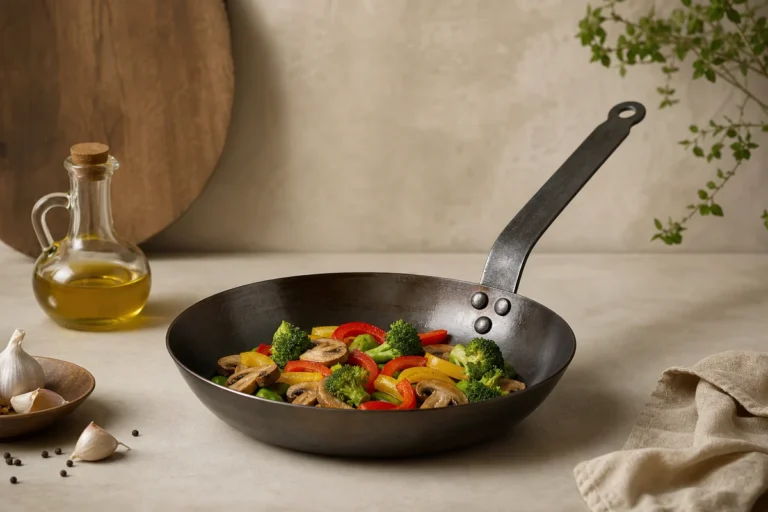
This is a big part of why cooks who want serious searing heat move away from coated pans in the first place. A nonstick pan asks you to keep the heat moderate to protect the surface. Carbon steel invites the high heat that gives steak a crust and vegetables a proper char, with no coating to worry about at any temperature.
What this means when you shop
For anyone leaving nonstick behind over health worries, this is the reassuring part. Bare carbon steel is free of forever chemicals by its very nature, not because of a special claim on the box. There is no coating to trust, no marketing promise to verify, and no film that wears out and needs replacing.
That said, buy from a brand that tells you plainly what the pan is made of and how it ships. A short care page confirming “bare carbon steel, beeswax rust protection” or “lightly pre-seasoned” tells you everything. Skip any pan with vague “special nonstick technology” language, since that usually points back to a coating.
If you want help choosing, our carbon steel buying guide walks through sizes, gauges, and handle styles. For the wider safety picture, see whether carbon steel pans are safe across everyday cooking.
Where PFAS live, and where they do not
The table below shows the pattern clearly. Coated pans are the ones with any PFAS history. Bare metal pans have none.
| Cookware | Has a synthetic coating | Can contain PFAS or PTFE |
|---|---|---|
| Carbon steel | No | No |
| Cast iron | No | No |
| Stainless steel | No | No |
| Nonstick (Teflon) | Yes | Historically yes |
| Ceramic nonstick | Yes (sol-gel) | Usually no |
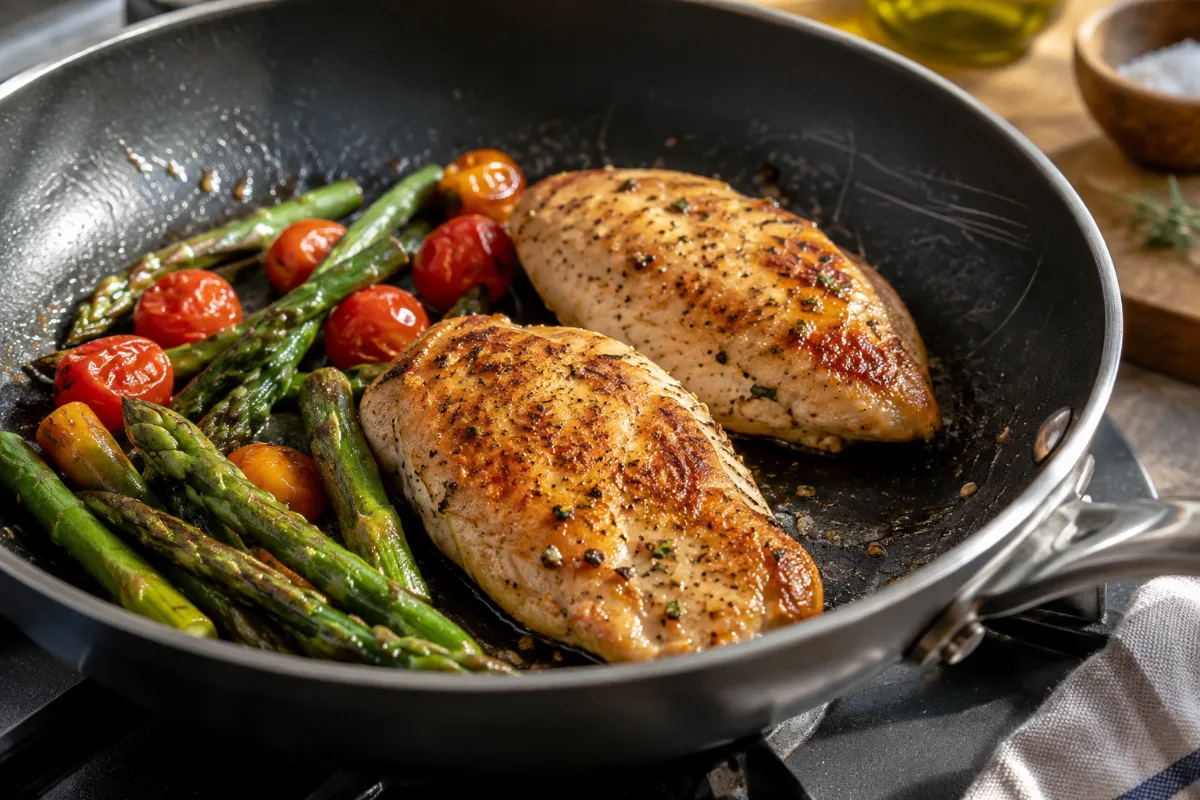
The takeaway is the top three rows. If a pan has no synthetic coating, it has no PFAS to worry about. Carbon steel, cast iron, and stainless all live in that safe group. Ceramic nonstick is a coating too, though its slick layer is silica-based rather than fluorine-based, which is why it usually avoids PFAS while still wearing out over a few years. Only the traditional Teflon-style pans carry the real PFAS history, and even those have changed since PFOA left production.
Frequently asked questions
Does carbon steel have Teflon?
Is carbon steel PFAS-free?
If there is no coating, why is it nonstick?
What is the black stuff on the pan then?
Do any carbon steel pans have chemicals on them?
The short version to remember
A carbon steel pan is iron, nothing more. Its nonstick surface is oil that you cured onto the metal yourself, so there is no synthetic layer to break down into your food. The only thing that might arrive on a new pan is a natural wax you wash off in the first five minutes.
If you are weighing your options across materials, our guide to non-toxic cookware puts carbon steel next to ceramic, cast iron, and stainless. And once your pan is home, learning how to season a carbon steel pan is the one skill that turns bare metal into a surface eggs slide across. For a direct performance comparison, see carbon steel versus nonstick pans.