How to Reseason a Carbon Steel Pan
As an Amazon Associate I earn from qualifying purchases, at no extra cost to you.
To reseason a carbon steel pan, scrub away the damaged or flaking layer with coarse salt and oil or a scouring pad, wash and dry the pan, then apply two or three thin rounds of oil heated past its smoke point. Full stripping is rarely necessary. Most problems are local and repair locally.
Reseasoning is not the same as stripping
People conflate these and then do far more work than they need to.
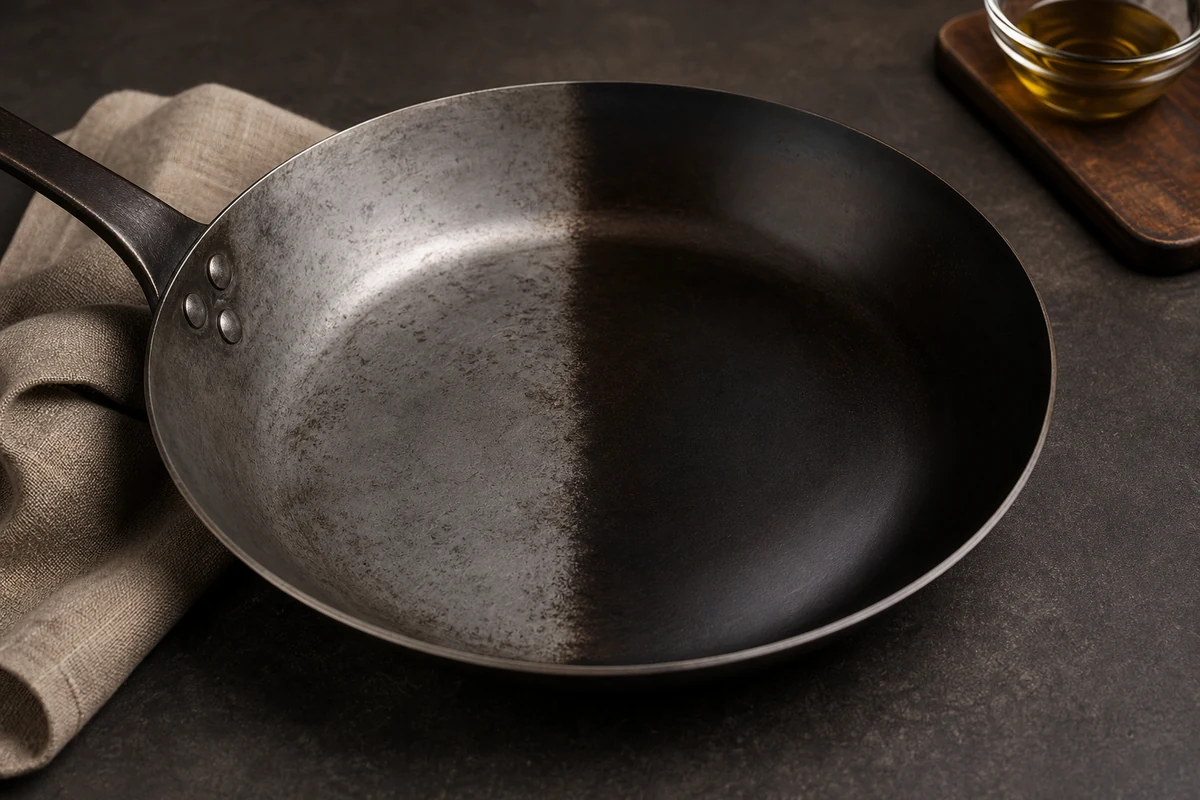
Reseasoning means adding fresh layers over what is already there, usually after scrubbing back a bad patch. This is what almost every problem calls for.
Stripping means removing everything down to bare metal and starting over. It is a last resort and it throws away good seasoning along with bad.
Start with the smaller intervention. You can always escalate.
When to reseason
- After cooking anything acidic. Tomatoes, wine or lemon strip layers. One round restores them.
- After removing rust. Rust removal always takes seasoning with it.
- When food starts sticking where it used to release.
- When patches flake. Remove the loose material, rebuild that area.
- When the surface turns tacky. Scrub the gummy layer off and redo it thinner.
You do not need a schedule. Regular cooking with fat maintains the layer on its own.
How to reseason
- Scrub the damaged area. Coarse salt and a little oil on a paper towel handles most cases. For flaking, use a scouring pad and take off everything loose. Anything that will come away later should come away now.
- Wash with hot water and dish soap. Remove all salt, oil and loose carbon.
- Dry on the hob. Low heat until no moisture remains.
- Apply a thin film of neutral oil. About half a teaspoon, spread everywhere, then wiped back until the pan looks almost dry.
- Heat until it smokes steadily. Hold for two minutes.
- Cool and repeat twice more.
- Cook something fatty. Bacon or sausages will do more than a fourth deliberate round.
When you genuinely need to strip
Three situations justify it.
Widespread flaking. If seasoning is peeling across most of the surface, patching leaves you with a permanently uneven pan.
Thick, uneven build-up. Years of heavy-handed seasoning can leave a lumpy surface that cooks unevenly.
Rancid smell. Excess oil left on a stored pan goes rancid, and the smell does not wash out.
How to strip a pan
Three options, in increasing severity.
Steel wool and effort. Slow, controlled, no chemicals. Fine for a small pan.
Oven cleaner. Spray, bag it, leave overnight, scrub. Effective and unpleasant. Wear gloves and work in ventilation.
Self-cleaning oven cycle. Burns everything off. Only for all-metal pans, never for wood or silicone handles, and it can warp thin steel. We would avoid this.
After stripping, the pan is bare metal and will flash rust within minutes. Dry it and start seasoning immediately. Method in how to season a carbon steel pan.
What not to do
Do not strip at the first problem. A tacky patch or a flaking edge is a local repair.
Do not use more oil to fix a sticky pan. Too much oil caused it.
Do not leave a stripped pan wet. Bare carbon steel rusts within minutes.
Do not sand aggressively with coarse grit. You can score the surface permanently. If you use sandpaper, keep it fine.
Worth reseasoning, or worth replacing?
A pan with patchy seasoning is always worth saving. A pan that has warped on a cheap electric coil is not, and no amount of oil fixes a base that no longer sits flat. If yours rocks, replace it: the Lodge 10 inch is $39.90 and thick enough to resist it, and the Merten & Storck 12 inch at $59.99 is the heaviest-gauge pan under $60 that we list.